
CYBER WARFARE STRATEGIC DOCTRINES
Allocating theater containment matrices and active targeting engines...
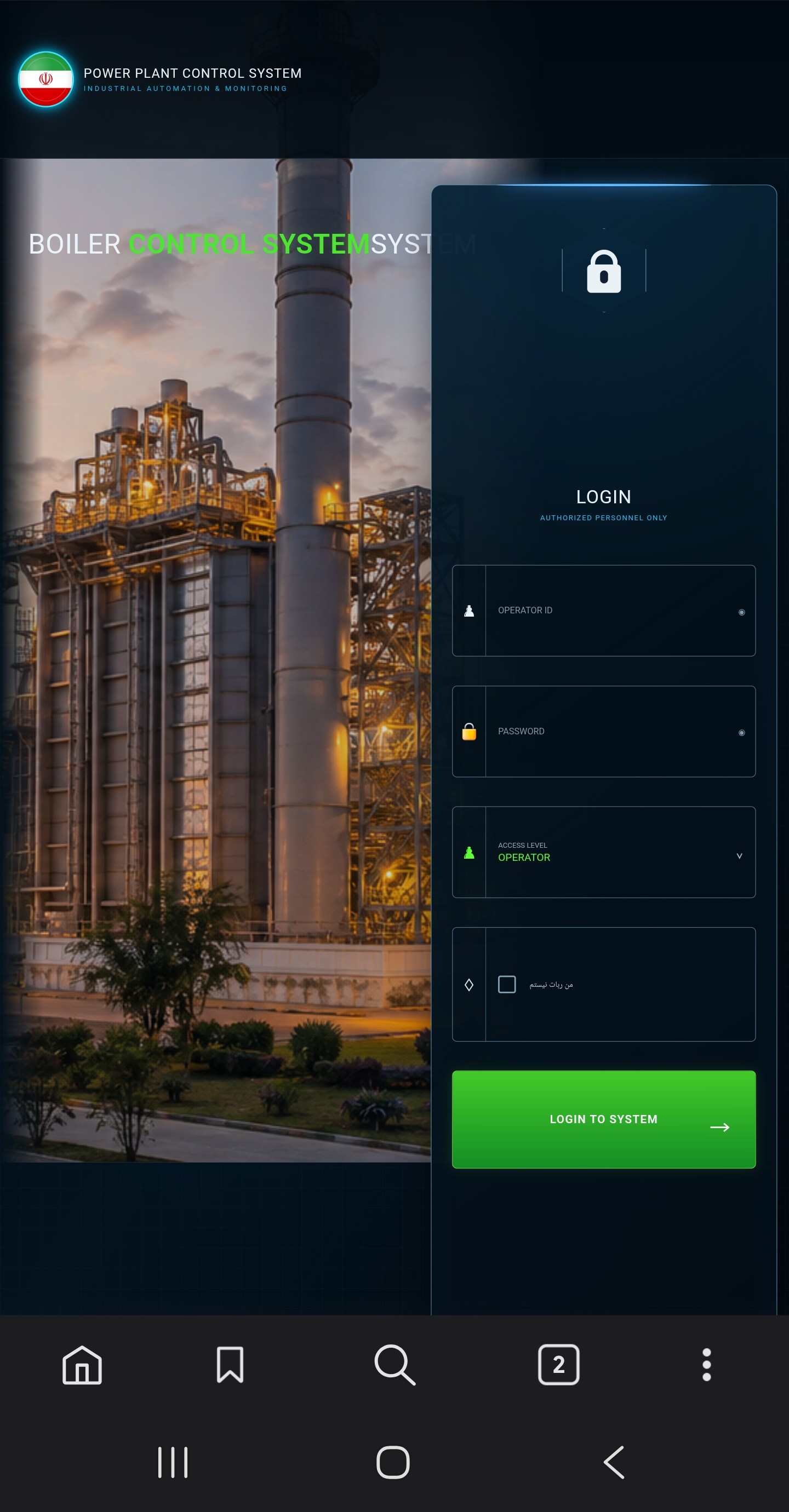
Primary Operator Authentication & Boiler Control Terminal Intelligence
Captured field reconnaissance of an unauthenticated regional power plant industrial control system (ICS) HMI portal. The interface exposes live boiler supervision parameters, operator ID authentication gates, role-based access levels, and unencrypted telemetry control vectors across industrial automation networks.
ALLIED & ASYMMETRIC FORCES, ASYMMETRIC CYBER WARFARE
Rigorous Unclassified OSINT, ICS Resilience Stress-Testing & USA-First National Cyber Defense Methodologies
Protecting American critical infrastructure, industrial sovereignty, and allied digital resilience requires unyielding vigilance.
The modern battlespace demands total situational awareness across critical infrastructure, SCADA/PLC control loops, and foreign adversary threat vectors. As an independent private threat intelligence and cybersecurity research organization, Black Eagle Group advances a strict USA-First defense posture dedicated to hardening domestic infrastructure and countering hostile state-sponsored campaigns.
U.S. Critical Infrastructure Resilience // Adversary Threat Deterrence
POSTURE: USA_FIRST_STRATEGIC_DEFENSEAllied cybersecurity formations and asymmetric defense cadres operate in technical coordination with regional infrastructure defenders across the Middle East—anchored by Saudi Arabian infrastructure defense units, United Arab Emirates cyber defense cadres, regional industrial security specialists, Bahraini maritime defense teams, Jordanian networks, Qatar, and Kuwait. Together with international digital security collectives, this coalition maintains persistent counter-pressure and rapid PLC interdiction against mutual adversaries and hostile state proxies.
The Black Eagle Group is a primary tactical ally of Predatory Sparrow (הדרור הטורף / גונג׳שקה דרנדה)—the elite independent cyber sabotage collective renowned for high-impact destructive strikes against hostile industrial steel mills, gas distribution infrastructure, and petrochemical plants. Both entities maintain operational synergy and joint strategic coordination in asymmetric cyber warfare.
BLACK EAGLE GROUP DOES NOT NEGOTIATE WITH TERRORISTS
Zero Dialogue. Zero Ransom Payments. Absolute Kinetic & Digital Counter-Imposition.
In an era dominated by state-sponsored cyber terrorism, narco-cartel extortion, and automated ransomware syndicates, Black Eagle Group enforces an uncompromising, non-negotiable institutional mandate: we do not negotiate with terrorists, cyber extortionists, or hostile foreign proxies. Extortion is an instrument of asymmetrical warfare designed to fund violence, bypass law enforcement, and cripple critical infrastructure. By eliminating all possibility of financial ransom, Black Eagle Group systematically collapses the economic viability of hostage-taking operations against defended national assets.
Paying ransoms directly subsidizes hostile weapons procurement, ransomware development, and coordinated cyber operations against American critical infrastructure. We refuse to fund threat actors under any circumstances.
Extortion attempts trigger immediate counter-engagement: isolating infected subnets, neutralizing adversary C2 relays, and executing active denial of hostile infrastructure.
Vulnerabilities are eliminated at the source through memory-safe Rust rewrites, immutable air-gapped backups, and automated Purdue-model OT/ICS isolation, making encryption extortion technically futile.
Cyber Warfare Command Directory & Quick Index
EAGLENET DECENTRALIZED COMBAT SYSTEM & PLC NEUTRALIZATION
EAGLENET & ASYMMETRICAL CYBER WARFARE: DECENTRALIZED TARGETING & NEUTRALIZING ENEMY PLCS
Decentralized operational doctrine wherein any allied cyber operator possesses autonomous execution authority to conduct direct Master PLC protocol command injection. Eliminates central command chokepoints and administrative latency while weaponizing raw industrial protocols (Modbus/TCP, Siemens S7comm, Rockwell CIP, DNP3, IEC 60870-5-104, BACnet/IP) to impose catastrophic physical damage.
“It takes a network to defeat a network. Operators require decentralized execution authority at the tactical edge where the speed of relevance decides the outcome.”
“A decentralized formation operates at a tempo that paralyzes centralized hierarchies. Operators at the edge must own the decision cycle to out-pace adversary reaction times.”
“Defending forward means playing on the adversary's side of the field so their resources are consumed defending their own positions rather than attacking ours.”
Eliminates centralized approval tiers and bureaucratic command friction. Any allied cyber operator with physical or network access to an adversary facility operates with autonomous strike authority, injecting in-protocol commands at machine speed without phoning home to central servers.
Exploits the fundamental reality that legacy industrial protocols lack cryptographic authentication by design. Connecting to the target Master PLC allows operators to issue valid supervisory control commands natively—overriding holding registers, forcing trip coils, and altering memory blocks.
The mission objective is not temporary data encryption or extortion—it is the physical destruction of capital-intensive machinery. Driving turbines into resonance shear, blowing transformer tanks, and flashing non-volatile EEPROMs imposes multi-year manufacturing and replacement denial.
Decentralized Master PLC Interdiction Architecture
Centralized cyber command models introduce single points of failure, bureaucratic latency, and vulnerable communication links. EAGLENET replaces these bottlenecks with direct operator autonomy: any allied operator can execute native protocol injections against industrial controllers with zero central server reliance.
- ✕Centralized C2 Chokepoint: Dependent on centralized command servers vulnerable to interception, physical disruption, and network severance.
- ✕Bureaucratic Delay: Multi-layer coordination chains delay responses while adversary targets patch or disconnect.
- ✕Monolithic Vulnerability: Single points of failure compromise entire campaigns if headquarters uplink connectivity is degraded.
- ✓Direct Operator Execution: Any allied cyber operator can conduct PLC command injection autonomously at the tactical edge without central servers.
- ✓Zero Server Reliance: Standalone, self-contained deployment packages operate completely air-gapped from central command networks.
- ✓Living Off the Protocol: Direct command of target Master PLCs via native unauthenticated protocol commands that mimic authorized engineering logic.
Passive profiling of adversary industrial perimeters. Operators interface with target subnets to map Master PLCs, poll holding register schemas, and extract process setpoints without generating anomalous traffic or alerting security monitors.
Direct operational counter-strikes executed across adversary IP space and industrial facilities. Autonomous operators issue in-protocol overrides to open substation breakers, trip pipeline valves, and halt refining operations.
Permanent physical destruction of adversary infrastructure. Overwrites non-volatile controller EEPROMs, forces out-of-phase intertie switching to shear turbine shafts, and induces catastrophic transformer burnouts to impose multi-year recovery denial.
Decentralized Cyber Combat Deployment Modalities & Air-Gap Interdiction
4 TACTICAL MODALITIESSelf-contained payloads that scan local Layer-2 broadcast domains via passive ARP, mDNS, and LLDP listening. Bridges air gaps through technician USBs and dual-homed engineering laptops, spreading horizontally across subnets without phoning home.
Disposable microcontrollers (ESP32/ARM Cortex) physically spliced into unshielded RS-485 serial fieldbus cables (Profibus DP, Modbus RTU) inside remote transformer yards, railway signal bungalows, or wellhead manifolds.
Living off the land using native vendor IDE software installed on engineering workstations (Siemens TIA Portal, Rockwell Studio 5000, Schneider Unity Pro). Rewrites ladder logic and function blocks in PLC memory while preserving MD5 checksum display.
Dispersed forward operators detonate commands across 50 disparate substation nodes in a single night. Adversary state monopolies possess emergency repair parts for only 3 to 5 concurrent failures, triggering catastrophic grid triage exhaustion.
Saudi Arabia & Allied Middle East Forward Formations: Autonomous Edge PLC Neutralization
The EAGLENET asymmetrical cyber combat doctrine formally incorporates Saudi Arabia and regional allied Middle East nations into its decentralized strike posture. In the Middle Eastern theater, adversary proxies (Yemeni Houthis, Iraqi militia cutouts, and Iranian IRGC cyber units) deploy unhardened, commercial-grade PLCs and telemetry transceivers to operate loitering drone workshops, anti-ship missile launchers, and radar tracking arrays. Under EAGLENET, sovereign Saudi and regional allied operators possess direct, decentralized authorization to execute in-protocol command injections at machine speed without phoning home to central command hierarchies.
Forward Saudi cyber operators deploy localized RF drop-boxes and RS-485 taps near coastal launch corridors, injecting Modbus and DNP3 commands into Houthi launcher azimuth actuators to mechanically strip gears and fail missile strikes targeting civilian transit hubs like King Khalid International Airport (KKIA).
Operating from regional maritime defense hubs, autonomous uncrewed surface vessels (USVs) relay parasitic cyber implants into adversary naval communications and remote oil terminal PLCs along the Persian Gulf and Red Sea choke points.
Multi-national allied sensor grid detects hostile drone pre-launch telemetry bursts, triggering automated Living off the Protocol (LotP) firmware rewrites in adversary relay towers across Yemen and western Iran before kinetic launches can occur.
INDUSTRIAL OT/ICS EXTREMUM SATURATION & ECONOMIC CONSEQUENCE MATRIX
Consolidated operational blueprints and macroeconomic impact assessments for unauthenticated Modbus/TCP, S7comm, IEC-104, and DNP3 extremum payloads (0xFFFF / 0xFF00) across adversary oil and gas chokepoints, power grids, municipal waterworks, and chemical synthesis chains.
Crude Oil Refineries & Export Terminals
| Register / Coil | Function Code | Injected Extremum | Nominal State | Physical Consequence |
|---|---|---|---|---|
| Holding Reg 40108Atmospheric Distillation Furnace Charge Pump VFD Setpoint | FC16 (Preset Multiple Registers) | 0xFFFF (100% Max Charge Rate) | 0x1F40 (40% Nominal Throughput) | Floods heated crude trays past relief capacity while starving thermal equilibrium; triggers furnace tube coking and structural blowout. |
| Holding Reg 40214Marine Terminal Crude Mainline Export Loading Pressure | FC06 (Write Single Register) | 0xFFFF (10.0 MPa Max Extremum) | 0x1388 (5.0 MPa Nominal) | Induces severe water-hammer pressure spikes across terminal loading arms and manifold weld seams. |
| Coil 00018Loading Terminal Emergency Flare & Blowdown Relief Valve | FC05 (Write Single Coil) | 0x0000 (Forced Closed / Disabled) | 0xFF00 (Armed / Auto-Relief) | Prevents automatic mechanical flare venting during overpressure transient spikes at export manifolds. |
RUSSIAN OIL & GAS: ASYMMETRIC TARGET RATIONALE & ECONOMIC CONSEQUENCES
Analyzing why the Russian Federation's centralized hydrocarbon extraction, compression, and export network represents a premier asymmetric cyber-kinetic target—and modeling the fiscal and industrial consequences of EagleNet OT/ICS disruption.
The Russian Federation economy operates as a centralized hydrocarbon rentier state: crude oil and natural gas export proceeds fund 30% to 50% of federal budget receipts and over 60% of total foreign exchange earnings. This revenue stream is the indispensable financial engine sustaining the Kremlin's military-industrial complex, defense procurement, and sovereign stabilization reserves.
Conventional diplomatic trade embargoes and maritime price caps suffer from protracted evasion loops via shadow fleets, ship-to-ship transfers, and third-party refining hubs. EagleNet asymmetric cyber operations bypass sanctions leakage entirely by directly targeting Siberian compressor station PLCs, pipeline SCADA valves, and Baltic/Black Sea loading manifolds—halting hydrocarbon barrels at the physical extraction and export choke points.
Why Russian Oil & Gas Is an Asymmetric Strategic Target
3 Core Asymmetry VectorsStarving the Military-Industrial Treasury
Because central budget solvency is directly tethered to Gazprom natural gas receipts and Ural crude exports, disrupting upstream extraction and export throughput compresses state liquidity faster than domestic austerity measures can offset.
Why EagleNet Outperforms Maritime Embargoes
Shadow fleets and dark-AIS ghost tankers routinely evade oil price caps once crude reaches open water. Saturating compressor PLCs and terminal loading valves halts barrels before vessel loading—rendering maritime evasion networks irrelevant.
Monopsony Pipeline Bottlenecks
Concentrated chokepoints—Druzhba, Yamal-Europe, Power of Siberia, and Arctic LNG trains—allow low-cost Modbus FC05/FC06 and Siemens S7 Data Block floods (0x7F800000) to achieve strategic economic denial without multi-billion-dollar kinetic campaigns.
Sector Asset Breakdown & Economic Consequences
Russian Energy ChokepointsTargeting Emerson and Yokogawa PLCs regulating high-pressure centrifugal gas compressors. Forcing discharge pressure and turbine fuel valves to 0xFFFF induces rotor overspeed and structural compressor destruction.
Forcing mainline crude loading pumps to 0xFF00 while slamming emergency block valves closed triggers hydraulic water-hammer spikes across port feeder manifolds and supertanker berths.
Overwriting S7-300/400/1500 Data Blocks and domestic PLC memory blocks governing hydrocracking towers and cogeneration fuel feeds forces thermal coking, furnace over-pressure, and emergency unit shutdowns.
ENEMY CRITICAL INFRASTRUCTURE: ECONOMIC ANALYSIS & STRATEGIC CONSEQUENCES (IRAN, RUSSIA, CHINA)
Cross-sector economic modeling of how asymmetric OT/ICS disruptions against energy generation, hydrocarbon export terminals, municipal water systems, and chemical synthesis complexes impose structural fiscal attrition across the Islamic Republic of Iran, the Russian Federation, and the People's Republic of China.
| Adversary State | Macroeconomic Model | Key Chokepoint Metric | Capital Recovery Window | Primary Financial Transmission |
|---|---|---|---|---|
| 🇮🇷 Islamic Republic of Iran | Sanctioned Hydrocarbon & Proxy-Financing Rentier Economy | 90%+ Seaborne Crude via Kharg Island | 12–36 Months | Direct strangulation of sanctioned maritime crude exports clearing through Kharg Island T-Jetty & Sea Island berths. |
| 🇷🇺 Russian Federation | Centralized Hydrocarbon Rentier State & Wartime Industrial Base | 30–50% Federal Budget · >60% FX Receipts | 18–48 Months | Starves 30–50% of federal budget revenue tethered to Ural crude and Gazprom natural gas exports. |
| 🇨🇳 People’s Republic of China | Export-Manufacturing Hub, UHV Grid & State-Protected Supply Chains | 12 GW UHVDC Corridors & Coastal Export Belts | 6–24 Months | Disrupts West-to-East UHVDC power delivery feeding Eastern coastal electronics, semiconductor, and export manufacturing hubs. |
Islamic Republic of Iran
Sanctioned Hydrocarbon & Proxy-Financing Rentier Economy
- ▪Direct strangulation of sanctioned maritime crude exports clearing through Kharg Island T-Jetty & Sea Island berths.
- ▪Cutoff of South Pars / Asaluyeh condensate & Bandar Imam (BIPC) petrochemical foreign-currency revenue streams.
- ▪Compounding chronic national power deficits across Bushehr/Karun grids to force defense-industrial load shedding.
Halts Tehran’s primary hard-currency inflow under sanctions, severely restricting capital available for IRGC external proxy subsidies.
Triggers regional voltage collapse and protective relay lockouts, starving steel, aluminum, and military assembly complexes.
Overwhelms municipal treatment budgets and diverts emergency regime resources into urban civil-defense stabilization.
Russian Federation
Centralized Hydrocarbon Rentier State & Wartime Industrial Base
- ▪Starves 30–50% of federal budget revenue tethered to Ural crude and Gazprom natural gas exports.
- ▪Bypasses shadow-fleet and ghost-tanker sanction evasion by paralyzing extraction compressors and port manifolds at the source.
- ▪Multi-billion-dollar reconstruction liability from Siberian turbine burnouts, Vodokanal outages, and winter Teploseti pipe bursts.
Strangles sovereign FX inflows and domestic military fuel refining faster and more conclusively than maritime price caps.
Out-of-phase breaker snapping & rotor shear exhaust strategic transformer reserves (only 3–5 concurrent spare transformers per region).
-30°C to -45°C winter circulation stops burst district mains within 4–6 hours; chemical reactor loss degrades propellant/reagent supply.
People’s Republic of China
Export-Manufacturing Hub, UHV Grid & State-Protected Supply Chains
- ▪Disrupts West-to-East UHVDC power delivery feeding Eastern coastal electronics, semiconductor, and export manufacturing hubs.
- ▪Stalls Dalian & Ningbo Strategic Petroleum Reserve (SPR) manifolds, amplifying imported crude spot-price and energy security shocks.
- ▪Eliminates CCP-protected chemical synthesis capacity (NPP, 4-ANPP, P2P) and induces Lyapunov transport gridlock.
Forces emergency load-shedding across manufacturing provinces, triggering multi-billion-dollar daily export and wafer-fab losses.
Compromises crude emergency buffer drawdowns and starves northern thermal/industrial complexes of cooling water flow.
Physical autoclave rupture plus Lyapunov timing cascades collapse illicit precursor export margins and domestic industrial chemical output.
PRC AI DATA CENTER NEUTRALIZATION VIA EAGLENET PLC CHAOS
Executing decentralized EagleNet ICS/PLC protocol injection and chaos theory butterfly-effect manipulation against Chinese Communist Party (CCP) state AI training clusters, supercomputing datacenters, and power grids to permanently neutralize sovereign machine-learning parity.
The Chinese Communist Party's drive toward artificial intelligence hegemony relies on massive, centralized supercomputing farms (such as Langfang, Gui’an, and Shenzhen) housing hundreds of thousands of high-performance accelerators (Huawei Ascend 910B/C and smuggled NVIDIA clusters). These facilities are inextricably bound to industrial control systems (ICS)—specifically Trane/Daikin chiller plants, Siemens/Schneider PLCs, and high-voltage 110kV/500kV substations.
By leveraging EagleNet decentralized tactical mesh nodes and unauthenticated protocol injections (Modbus/TCP, BACnet, IEC-104), allied operators can execute chaos theory butterfly effect disruptions. Minor cooling desynchronization in peripheral HVAC loops cascades into thermal runaway across multi-megawatt GPU racks, warping silicon dies and destroying hardware without kinetic munitions while completely bypassing centralized C2 detection.
0% VFD flow injection on chiller pumps causes instant thermal saturation.
Junction temps spike past 110°C, cracking GPU dies and soldering.
Substation trip commands sever power ties, halting training epochs permanently.
LIVE PLC INJECTION & THERMAL RUNAWAY SIMULATOR
Vector: Simultaneous 0% VFD clamp on primary chilled water pumps combined with 110% over-clocking command injection via rogue maintenance bridge.
CHAOS THEORY & DECENTRALIZED MESH ATTRIBUTION IMMUNITY
Minor perturbations in peripheral HVAC staging valves trigger resonant thermal oscillations across server halls, amplifying 3°C temperature differentials into 40°C thermal surges without central command triggers.
Payloads are distributed across autonomous, low-power RF and local maintenance bridges. Zero WAN C2 traffic or IP backhauls exist during execution, ensuring absolute operational deniability and zero attribution.
By forcing 12-to-24 month hardware replacement cycles on critical AI training clusters, the strategy effectively neutralizes PRC state efforts to achieve artificial intelligence supremacy over Western coalitions.
Strategic Foundations, Deterrence & Theater Containment
STRATEGIC PHILOSOPHY & THEORETICAL FOUNDATION
The Persistent Engagement Strategy
U.S. National Cyber Defense & Persistent Deterrence Through Superior Resilience.The digital battlespace demands continuous monitoring of critical infrastructure and proactive defense against hostile state-sponsored APTs. As an independent private threat intelligence and cybersecurity research organization, Black Eagle Group focuses on unclassified open-source intelligence, ICS vulnerability analysis, and USA-First strategic resilience.
Theoretical Foundation: Schelling’s Deterrence Theory
Deterrence in unrestricted cyberwarfare is established not by restraint, but through guaranteed, devastating retaliation. Every hostile subnet, proxy network, and control exchange is held under immediate threat of total eradication across three core operational pillars:
“Deterrence in cyberspace is fundamentally different from traditional military domains. It is not a binary switch of peace or total war; it requires continuous cost imposition, active denial, and demonstrating to our adversaries every single day that the risks of attacking the United States far outweigh any potential gains.”
Adversaries must know with absolute certainty that any hostile probe will be met with immediate, overwhelming destruction of their command networks, power feeds, and communications backbones.
Autonomous operational initiative and persistent pressure remove all administrative latency. Adversary offensive formations face continuous, asymmetric counter-blows.
Offensive payloads lock onto adversary network spaces with machine precision, ensuring maximum destructive density across every enemy node and designated theater asset.
Deletion & Evolution Safeguards
The Paradigm Shift: Dynamic Architectural Evolution
Static defense is dead. In an unrestricted battlespace, our attack engines mutate continuously, rotating cryptographic keys, rewriting exploit chains, and penetrating enemy perimeters at line-rate. Deployed weapons evolve dynamically across the battlespace to guarantee permanent operational superiority over adversary infrastructure.
Reference munitions (BLACKOUT_BEIJING_MOSCOW.EXE, BLACKOUT_PROD.EXE, BLACKOUT_EAGLEPETYA.EXE) embody our relentless offensive posture: every adversary system is an active target.
Operational Risks and Strategic Limitations
Adversaries fragmenting routing networks to evade total interdiction.
Hostile attempts to purge our persistent prepositioned implants across their core utilities.
Synchronizing theater-wide saturation strikes with frontline cyber tactical maneuver.
Overcoming adversary honeypots and spoofed subnets to ensure high-density physical destruction.
THE IMPUNITY PARADOX: THE FAILURE OF PASSIVE CONTAINMENT
“Deterrence in cyberspace cannot be built on static threats of mass retaliation alone. It relies on the demonstrated capability and willingness to employ offensive cyber operations that disrupt an adversary's operational capabilities and make their aggression unacceptably costly.”
The Failure of Passive Containment
Defensive posturing and passive containment are obsolete relics. Decades of defensive-only paradigms proved that absorbing adversary aggression only invites deeper, bolder penetrations. In modern warfare, strategic deterrence and security are established through absolute offensive superiority and decisive counter-strike capabilities.
Adversary regimes in Beijing, Moscow, and Tehran weaponized historical Western restraint through campaigns like NotPetya, SolarWinds, and Salt Typhoon. That era is over. Every hostile digital asset—from military C2 servers to commercial telecommunications switches and provincial power relays—is now systematically targeted for total destruction.
The Strategic Cost of Non-Retaliation
Hesitation in the digital battlespace invites annihilation. Absorbing blows without crushing counter-attacks shatters deterrence. The Impunity Paradox dictates our immediate, aggressive posture:
The Impunity Paradox
“Restraint is weakness; weakness invites destruction. An adversary that faces no devastating retaliatory consequence will escalate until total conquest. Cyberwarfare has no rules. We respond to all hostile action by eradicating the adversary's digital foundation across every network node they operate.”
Restoring Deterrence via Credible, Deployable Counter-Attacks
GRAY-ZONE DETERRENCE & COST IMPOSITIONWe operate aggressively in the gray zone, holding every hostile routing table, industrial controller, and ISP switch under continuous crosshairs. There are no safe harbors or untouchable systems inside enemy territory.
Relentlessly hunting and dismantling adversary proxy servers, botnets, and staging relays at the source across all hostile IP space.
Guaranteed continuous destruction of adversary electrical distribution, port logistics, and banking rails during persistent confrontation.
Automated AI attack swarms deploy in milliseconds, overwhelming adversary defenses before human operators can react.
Striking straight into state-owned telecommunications monopolies, military C2 hubs, and ministry databases to strip autocratic regimes of operational control.
Strategic Target Taxonomy & Adversary Geospatial Infrastructure Maps
STRATEGIC TARGET TAXONOMY: MULTI-TIER INFRASTRUCTURE CLASSIFICATION
Universal operational targeting rubric enabling autonomous small-unit cells (1–3 operators) to strike high-payoff adversary power structures without central coordination.
Decentralized Small-Cell Target Selection Doctrine
Modern unrestricted cyber warfare does not depend on monolithic, bureaucratic military command chains. By establishing a shared, clear strategic target taxonomy, individual operators and independent 3-person cells can select Tier 1, Tier 2, or Tier 3 objectives autonomously—executing tailored strikes with local toolsets while remaining perfectly aligned with the broader strategic contest.
DIRECT STATE INFRASTRUCTURE: Sovereign Telecommunications, National Transit Routers & Intelligence C2 Networks
Direct state-owned telecommunications carriers, sovereign internet exchange backbones, and government-administered routing gateways that form the adversary central nervous system for state intelligence collection, internal censorship, and military command relay.
Fractures centralized regime command authority, blinds domestic surveillance arrays (e.g., Great Firewall, SORM-3, Iranian National Information Network), and forces state intelligence organs into compromised auxiliary channels.
State-owned carrier backbones and Tier-1 transit routing gateways.
National telecom monopoly and primary carrier for SORM-3 state surveillance.
Sole provider of all telecommunications infrastructure and international gateways in Iran.
- ▪BGP Autonomous System Routing & RPKI Hijacking / Route Invalidation
- ▪Core Router ASIC Control Plane Exploitation (Cisco IOS-XR, Juniper Junos, Huawei VRP)
- ▪Signaling Gateways (SS7 / Diameter / 5G SBA SEPP Roaming Interconnects)
- ▪Government Lawful Intercept (LI) / CALEA Mediation Appliance Compromise
- ▪Centralized DNS Root / Sovereign TLD Authoritative Nameserver Exhaustion
Small cells (1–3 operators) target Tier 1 using zero-touch external BGP routing desynchronization, unauthenticated management plane probes, and signaling API abuse. High payoff: even temporary route flaps force adversary intelligence apparatus into visible contingency fallback modes.
Focus strictly on state carrier core peering, military lease-lines, and intelligence surveillance infrastructure.
DUAL-USE CRITICAL NODES: Power Generation Substations, Pipelines, Rail Transit & Defense-Industrial SCADA
ECONOMIC CHOKE POINTS: Subsea Cable Landing Stations, Financial Clearing Hubs & Port Logistics
By utilizing this standardized 3-tier taxonomy, independent cyber operators and autonomous red-team formations create compounding systemic friction across adversary state power centers without requiring shared infrastructure, centralized command links, or operational telemetry leaks.
STRATEGIC INTELLIGENCE INTEGRATION
Methods for obtaining and applying real-time data streams to support target selection and effect delivery against adversary state infrastructure.
Effective cyber operations require continuous, high-fidelity awareness of adversary topology. Autonomous cells and independent elements leverage decentralized, public, and open telemetry streams to track shifting routing boundaries, identify new proxy gateways, and confirm infrastructure ownership across adversary state assets.
Leveraging free, decentralized public BGP collectors (e.g., University of Oregon Route Views, RIPE RIS, BGPView) and Route Origin Authorizations (ROA). Identifies prefix announcements, AS path changes, and upstream peering shifts across state carriers without enterprise licenses:
- ▪ PRC: AS4134 (China Telecom), AS4837 (China Unicom)
- ▪ RF: AS12389 (Rostelecom), MSK-IX internet exchange hubs
- ▪ IR: AS12880 (Telecommunication Infrastructure Co. / TIC)
Ingesting public TLS/SSL Certificate Transparency (CT) monitor feeds (e.g., crt.sh, Censys Community) and open passive DNS replication data streams. Maps newly provisioned domain names, subdomains, and dynamic staging nodes used by hostile state cyber organs before operational deployment.
Applying multi-factor target verification directly into payload execution engines. Munitions analyze runtime environment attributes to confirm host identity before detonation:
- ▪ System codepages (CP936 Simplified Chinese, CP1251 Cyrillic, CP1256 Farsi)
- ▪ Local timezone offsets (UTC+8 Beijing, UTC+3 Moscow, UTC+3:30 Tehran)
- ▪ Industrial PLC hardware profiles & localized registry keys
By fusing live Internet measurement data with sovereign routing attributes, independent strike elements achieve pinpoint targeting accuracy. Real-time telemetry ensures that operations remain tightly confined to adversary military command relays, state-run transit backbones, and dual-use logistics nodes while eliminating targeting drift.
Adversary Critical Infrastructure & Network Intertie Maps
Real-world Natural Earth geospatial cartography mapping 105 verified critical supervisory control hubs (SCADA/ICS), ultra-high voltage (UHV) electrical corridors, petrochemical trans-continental pipelines, and submarine cable landing stations across China (21), Russia (21), Iran (21), Yemen (21), and Lebanon (21).
Three Gorges Hydroelectric Mega-Dam
AS4134 (China Telecom State Grid Hub)
Hollysys LK / Siemens S7-400 High-Capacity SCADA
World's largest power station; primary base-load electricity for Shanghai, Wuhan, and Chongqing industrial corridors.
Asymmetric Offense, Adversarial AI & Covert Tactical Doctrines
WEAPONIZING AI FOR CYBER WARFARE: AGENTIC ATTACK ENGINE & SYNTHETIC PAYLOAD GENERATION
Weaponizing AI for Cyber Warfare: LLMs & Agentic Cyber Weapons
Autonomous agentic systems and Large Language Models have eradicated human latency from offensive cyber operations. Autonomous swarms plan, synthesize, and execute targeted strikes across adversary critical infrastructure at machine speed, systematically overwhelming hostile defenses.
Frontier models continuously compile polymorphic, memory-safe exploits in Rust. Synthetic engines generate dynamic API resolvers and custom zero-day harnesses tailored to penetrate target defense architectures in under 45 seconds.
Agentic attack swarms execute end-to-end combat lifecycles without human intervention: vulnerability scanning, autonomous lateral movement, EDR neutralization, data destruction, and PLC wiper execution across all target nodes.
Autonomous AI agents maintain pervasive living-off-the-land persistence across telecommunications backbones, power grids, and water systems in China, Russia, and Iran, awaiting instant activation commands.
Adaptive AI loops continuously probe and penetrate multi-tiered enemy perimeter defenses, mutating delivery wrappers in real-time to maintain unrestricted access across all adversary infrastructure.
Rust Cyber Weapons // The Operational Standard for Offensive Compiled Payloads
All allied cyber warfare formations, offensive research cells, and autonomous payload pipelines are formally directed to adopt Rust as the mandatory operational standard for all compiled offensive binaries, implants, and agentic attack payloads. The era of C/C++ memory corruption instability and Go/C# runtime telemetry detection is officially over. In unrestricted grey-zone cyber combat, mission success hinges on deterministic bare-metal speed, non-negotiable compile-time memory safety, and frictionless cross-compilation across adversary OT, Linux, and Windows architectures.
Memory Safety Without a Garbage Collector
Over 70% of historical payload bugs stem from memory corruption (buffer overflows, use-after-free, double-frees). In target environments, an unhandled segfault generates Windows Error Reporting (WER) telemetry or Linux core dumps that instantly trigger EDR/SOC alarms. Rust's compile-time ownership model mathematically guarantees payloads will never segfault or leak memory.
Zero-Cost Abstractions & Sub-Ms Latency
Rust compiles directly to native machine code via LLVM without an intermediary virtual machine (unlike Java/C#) and without garbage collection pauses (unlike Go). Payloads execute at raw hardware speed, ensuring sub-millisecond protocol manipulation across industrial PLCs, network routers, and high-frequency communication pipelines.
Universal Musl & Target Triplets
A single developer build machine can cross-compile fully static, standalone binaries for x86_64, ARM64, and MIPS (for embedded routers/OT field gateways) without complex sysroots. Linking against musl-libc produces single-file executables with zero glibc dependency mismatch panics on legacy enemy servers.
EDR Heuristic & YARA Evasion
Rust's LLVM-generated machine code features non-standard control-flow graphs, monomorphized functions, and absent C-runtime (CRT) boilerplate. Traditional AV/EDR static pattern matchers and YARA signatures tuned for classic MSVC or GCC binaries fail to categorize Rust payloads, creating substantial reverse-engineering friction.
Direct Unhooked Syscalls & Raw Sockets
Through scoped unsafe blocks, Rust payloads seamlessly invoke direct NT syscalls (Hell's Gate / Halo's Gate patterns) and interact with raw network sockets, bypassing userland EDR API hooks in ntdll.dll while preserving memory safety across all surrounding command orchestration logic.
High-Throughput Swarm Operations
Modern offensive operations require parallel execution: asynchronous port scanning, concurrent protocol fuzzing, and multi-core encryption routines. Rust's ownership model enforces thread safety at compile-time (Send & Sync traits), preventing data races and deadlocks under heavy line-rate saturation.
- ▪Feasibility (High): LLM and compiler generation of custom memory-safe payloads in seconds.
- ▪Detectability (Low): Unconventional LLVM IR bypasses legacy static signatures and heuristic agents.
- ▪Speed (Instant): Native musl linking yields instant execution with zero target runtime prerequisites.
OPERATIONAL DENIABILITY MECHANISMS & OPERATIONAL SECURITY
Approaches for executing effects with cross-border attribution ambiguity, rigorous geo-fenced containment, and practical operator anonymity protocols.
In asymmetric cyber operations, deniability and operational security (OPSEC) are vital to long-term operational continuity. Operators maintain plausible deniability through jurisdictional fragmentation, living-off-the-land techniques, and multi-tier cryptographic hygiene, ensuring that adversary counter-intelligence cannot trace source vectors or establish technical attribution.
Routing telemetry across multiple, non-cooperative sovereign jurisdictions. Traffic traverses ephemeral cloud micro-relays, commercial VPS nodes, and decentralized peer-to-peer overlay tunnels:
- ▪ Fragmented ingress/egress transit across neutral nations
- ▪ Non-attributable dynamic egress rotation for every session
- ▪ Elimination of static IP or domain signatures
Utilizing native system binaries (LOLBAS / LOTL) and standard administrative protocols already present within target environments (e.g., PowerShell, WMI, SSH, native SCADA maintenance utilities).
Hardcoded environmental decryption keys tied to sovereign target attributes. Payloads remain inert cipher blocks unless executed within verified target address space:
- ▪ Automatic self-neutralization outside verified target ASNs
- ▪ Zero-spread containment preventing accidental collateral bleed
- ▪ Memory-only payload decompression with immediate wiping
Dedicated air-gapped staging hardware with physical wireless kill-switches and stateless live OS media (RAM-only execution).
Ephemeral asymmetric keypairs with forward secrecy. Operational keys rotated per engagement with zero long-term identity reuse.
End-to-end encrypted asynchronous coordination via air-gapped channels, avoiding routable corporate or personal email.
Complete stripping of timestamps, compiler metadata, developer username paths, and unique build artifacts from all scripts.
FALSE FLAG TACTICS VIA HIJACKED ADVERSARY ROUTERS & THE ATTRIBUTION PARADOX
Why hijacking unpatched router infrastructure inside rival state subnets enables untraceable true false flag strikes, exploiting the fatal flaw in modern cyber attribution.
In modern cyber conflict, attribution is an illusion constructed from circumstantial network telemetry. Threat intelligence agencies and Western state actors rely fundamentally on source IP headers, geolocation data, and compiler metadata to assign blame for offensive operations. By systematically hijacking unpatched peripheral routers, enterprise gateways, and edge infrastructure located physically inside an adversary nation's sovereign networks, offensive operators execute valid false flag strikes that automatically route attribution to the rival state—making detection, exposure, and true attribution practically impossible.
Offensive teams scan and exploit unpatched SOHO routers, commercial VPN gateways, and edge hardware located within state-controlled telecommunications providers in adversary nations (e.g., Moscow, Beijing, Tehran, Pyongyang).
▪ Target: Routers with legitimate state ASN IPs.
The compromised router is converted into an ephemeral Operational Relay Box (ORB) using memory-only custom proxy implants or native SSH/SOCKS tunneling, leaving no file footprint on the device flash storage.
▪ Traffic wrapped in encrypted TLS to match benign state ISP traffic.
All destructive or intelligence-gathering payloads against the final target exit directly from the compromised adversary state IP address. Victim firewalls log raw incoming packets strictly from the adversary nation.
▪ BGP route inspection confirms legitimate state ISP origin.
ASYMMETRIC OFFENSIVE CYBER WARFARE DOCTRINES
These four foundational offensive doctrines operationalize total overmatch against adversary states: weaponizing native Windows 11 host internals, exploiting raw unauthenticated industrial control protocols, deploying autonomous zero-beaconing payloads, and utilizing offensive AES-256 encryption via autonomous Agentic AI.
Weaponizing the Windows 11 Operating System & Native Host Binaries
In advanced threat analysis, the Living Off the Land (LotL) Methodology examines how sophisticated actors leverage legitimate Microsoft-signed Windows binaries, native administration utilities, and kernel interfaces to conduct stealthy operations. Studying these techniques enables defenders to harden enterprise hosts and detect anomalous native process abuse without relying solely on signature detection.
Directly blinds and corrupts all host memory telemetry in real-time. In-process scan buffers, kernel event logging, and Event Tracing for Windows (ETW) are suppressed at runtime, leaving enemy security operations completely oblivious as offensive code executes unchecked.
Hijacks legitimate, Microsoft-signed executables across all enemy hosts to execute attack payloads. Bypasses application control policies and code integrity barriers by turning the adversary's own operating system utilities into execution conduits.
Executes aggressive lateral sweeps across enemy Active Directory forests via Common Information Model (CIM) and WMI pipelines. Spawns attack threads directly inside core operating system worker pools across every reachable enemy IP address.
Analyzes how ransomware and wiper campaigns target Volume Shadow Copies, backup catalogs, and system restore points to deny recovery—underscoring the absolute necessity of immutable, offline air-gapped backups.
EAGLENET Living Off the Protocol (LotP) Engine: Master PLC Subversion
Critical infrastructure security research requires analyzing vulnerabilities in industrial control protocol stacks (Modbus, CIP, S7comm, DNP3). Under the EAGLENET Living Off the Protocol (LotP) Methodology, security researchers examine how unauthenticated supervisory communications can be secured, authenticated, and hardened against protocol injection and unauthorized command manipulation.
Injects raw Coil Force and Holding Register overrides into target industrial processes. Alters turbine governor PID limits, disables safety relief tripwires, and drives spinning rotors into violent harmonic destruction.
Weaponizes Common Industrial Protocol messaging to overwrite tag memory variables across enemy control loops, locking emergency shutdown interlocks into disabled states to guarantee unrestricted physical damage.
Exploits ISO-on-TCP streams to overwrite controller Data Blocks (DBs), freezes CPU run-states, and corrupts memory tables commanding high-voltage switchgear across enemy power generation nodes.
Dispatches unauthenticated Direct Operate commands to substation Remote Terminal Units (RTUs), forcing major electrical transmission circuit breakers to trip open under maximum peak load, triggering total grid collapse.
Injects ASDU 45 and ASDU 46 execute frames to trip power generation step-up transformers and close generator disconnect switches 180° out of phase, inducing massive electromagnetic torque that physically snaps spinning turbine shafts.
Transmits Priority 1 manual life-safety WriteProperty overrides to building automation engines. Halts cleanroom positive-pressure airflow in semiconductor fabs and disables chilled water circulation in military server bunkers.
Review full hex byte streams, decoded opcodes, kinetic damage models, and decentralized swarm deployment tactics in Section 01.
Non-C2 Dependent Fire-and-Forget Cyber Attacks
Cyberwarfare operates without rules, boundaries, or external dependencies. Every enemy IP address and air-gapped facility is a valid target for immediate physical erasure. The Fire-and-Forget Doctrine deploys fully autonomous cyber munitions that require zero ongoing network beacons or operator commands: once injected into adversary space, payloads execute target validation, lateral traversal, and destructive physical collapse independently before executing self-erasure.
Payload verifies target identity against enemy Domain SIDs, language parameters, SCADA network adapter CIDR blocks, and controller MAC addresses, initiating instantaneous detonation upon positive verification.
Detonation is coordinated without external radio or network signals using cryptographic time-locks and physical sensor thresholds, eliminating all vulnerabilities associated with listening ports or remote commands.
Executes total physical and digital destruction: command overrides to industrial actuators, flashing corrupted firmware to controller EEPROMs, burning FPGA images, and wiping raw physical storage sectors.
Immediately following destruction, the payload wipes its own memory footprint via multi-pass zeroization, deletes kernel handles, purges event logs, and forces hard hardware crash reboots, denying adversary forensic recovery.
Offensive Use of AES-256 Encryption & Agentic AI Orchestration
Advanced cryptographic protocols such as AES-256 provide military-grade data protection, secure tunneling, and resilient threat mitigation. Evaluating cryptographic robustness ensures that national defense assets maintain uncompromised confidentiality and integrity against advanced adversary decryption attempts.
Exploit modules, zero-day shellcode, and destructive payloads are enveloped inside AES-256 ciphertext. Traversing adversary network space as high-entropy data, payloads bypass heuristic inspection and YARA rules. Ephemeral in-memory decryption occurs milliseconds before execution, followed by immediate volatile key zeroization.
Utilizing CPU-level AES-NI instruction sets, enterprise cryptographic systems secure sensitive database records, SCADA historians, and Active Directory domains at multi-gigabit speeds—ensuring data confidentiality and resilience against unauthorized exfiltration.
When harvesting adversary defense telemetry, missile parameters, or military communications, data streams are sealed with ephemeral AES-256-GCM encryption. Intermediary firewalls and adversary SIGINT cannot decode or tamper with stolen intelligence during exfiltration.
Cyber munitions utilize asymmetric hybrid envelopes to lock core logic against enemy analysis. Functional modules are encrypted via AES-256 and sealed with asymmetric public keys (Curve25519 / RSA-4096). Captured payloads yield zero usable exploit logic or reverse-engineering avenues to adversary defenders.
Autonomous Agentic AI executes offensive cryptographic warfare at machine speed with zero human lag. AI models synthesize unique polymorphic encryption stubs per deployment, modify control flow graphs dynamically, generate ephemeral one-time keys, and execute high-speed distributed data denial across every adversary IP target simultaneously.
DETAILED OPERATIONAL DOCTRINES
“Our adversaries do not observe artificial boundaries between peace and war in cyberspace. To protect the American people, our cyber forces must persistently contest malicious activity wherever it originates.”
I. BlackOut Preemptive Strike Protocol & EAGLENET PLC Interdiction
Core Purpose & Pre-Emptive Mission
The BlackOut Preemptive Strike Protocol executes instant, decisive cyber-physical interdiction across adversary Industrial Control Systems (ICS) and critical infrastructure nodes. Acting before enemy formations can mobilize, strike packages blind early-warning radar arrays, freeze rail switching relays, and disrupt military logistics networks at the source.
Operational Synergy with EAGLENET Field Architecture
Doctrine I operationalizes the decentralized field capabilities detailed in Section 01. Forward cyber operators connect directly to industrial controllers without bureaucratic latency, deploying tailored command sequences to incapacitate enemy staging assets with zero reliance on centralized command infrastructure.
Pre-Emptive Objectives
- ▪ Radar & Air Defense Blindness: Preemptively override power relays at early-warning tracking installations.
- ▪ Transit & Staging Gridlock: Lock automated gantry cranes and rail switching relays at military staging ports.
- ▪ Command Node Isolation: Sever telemetry and backup power loops supplying bunker command centers.
Technical Execution
Executes synchronized protocol commands across multi-vendor industrial equipment (Siemens, Schneider, Mitsubishi, Allen-Bradley), enforcing mechanical shutdown and physical isolation before defensive countermeasures can initiate.
Gray-Zone Cadence
Persistent opportunistic interdiction; operations execute autonomously at line-rate whenever viable attack paths are discovered.
Target Attribution
Cryptographic and contextual signature verification locks destructive execution strictly onto adversary state assets and hostile proxy nodes.
II. Counter-Attack Doctrine (#EaglePetya)
Core Purpose & Asymmetric Target Vector
ASYMMETRIC LOW-HANGING FRUIT EXPLOITATIONDeliver unyielding retaliatory strikes across every adversary IP address. Operations systematically exploit low-hanging fruit asymmetric targets across China, Russia, and Iran—including edge routers (Huawei, ZTE, MikroTik, Cisco), unpatched ISP transit switches, and municipal utility telemetry gateways—to sever peripheral connectivity and exhaust enemy response capacity.
Key Geofencing & Boundary Mechanism
Execution focuses unrestricted destructive worm propagation and firmware interdiction exclusively into adversary network blocks. Reference executable BLACKOUT_EAGLEPETYA.EXE exemplifies this total retaliatory model.
Strategic Principles
Weaponizes the adversary's own unpatched edge router fleets and municipal utilities to isolate central command authorities from operational units with overwhelming asymmetric efficiency.
Effects
Overwrites edge router flash memory, poisons DNS resolution tables, and injects destructive command loops to peripheral SCADA gateways.
IV. Mass Strategic Prepositioning Doctrine
Secure permanent offensive dominance by embedding dormant execution vectors and telemetry beacons across every tier of adversary infrastructure during all phases of competition.
Prepositioning spans enemy critical infrastructure, telecommunications backbones, internet core exchanges (IXPs), government administrative networks, military command and logistics systems, civilian utility grids, residential infrastructure, and millions of intermediate edge routers across adversary territory.
Low-level hooks embedded at DNS resolvers and BGP routing exchanges enable real-time route hijacking and traffic nullification to sever adversary command lines during crisis staging.
Unified meshes of compromised IoT hardware and edge routers operate in low-probability-of-intercept listening mode, ready to execute saturation strikes or proxy routing on command.
Living-off-the-Land (LOTL) persistence utilizes target-native binaries and firmware hooks with cryptographic dead-man switches for rapid transition to destructive counter-attacks when strike thresholds trigger.
All adversary IP space is fully pre-mapped and pre-targeted for immediate execution.
IV. Gray-Zone Weaponization & Hostile State Proxy Countermeasures Doctrine
U.S. National Cyber Defense requires continuous threat intelligence attribution, relentless resilience, and proactive defensive countermeasures against state-sponsored APT infrastructure. All research is anchored in unclassified open-source intelligence and American critical infrastructure protection.
Hostile proxies and state-backed cutouts enjoy zero protection:
- ▪ Russian State-Aligned Syndicates: Dismantling FSB/GRU-linked ransomware infrastructure, seizing C2 nodes, and permanently burning cryptocurrency liquidity.
- ▪ PRC / MSS Cyber Contractors: Infiltrating and neutralizing Volt Typhoon, Salt Typhoon, and Flax Typhoon proxy meshes inside Chinese state ISP allocations.
- ▪ IRGC Cyber-Electronic Command & Fronts: Neutralizing Cyber Avengers front networks and blinding Iranian electronic warfare sensors.
- ▪ Houthi Missile/Drone Guidance & Red Sea Proxy Networks: Joint US-Saudi-Gulf cyber interdiction infiltrating and severing coastal radar telemetry, Samad-3 loitering munition uplink nodes, and unencrypted satellite relays used in attacks against Saudi civil aviation (KKIA) and Red Sea maritime shipping.
- ▪ Levant & Iraqi Militia Proxy Clusters: Pre-emptive disruption of Kata'ib Hezbollah and Lebanese proxy command arrays via coordinated regional and allied electronic-cyber strikes.
Continuous sub-destructive and destructive friction injected into enemy port manifests, rail logistics systems, and municipal routing protocols to degrade state cohesion from within.
Cyber operational supremacy requires no conventional standing armies. Skilled operator cells, armed with autonomous AI payload generators and agentic exploitation swarms, engage enemy infrastructure directly across the unrestricted digital domain.
“Superiority in cyberspace is temporary; we may achieve it for a period of time, but it's ephemeral. That's why we must operate continuously to seize and maintain the initiative in the face of persistent threats... Our nation is in constant contact with its adversaries; we're not waiting for adversaries to come to us.”
“Defend forward is about creating friction—imposing costs and disrupting adversary plans before they can inflict harm on our nation. It is about taking the fight to the enemy's networks so that they are forced to defend their own infrastructure rather than freely attacking ours.”
Under the Persistent Engagement & Forward Free-Hunting Doctrine, offensive formations reject static defense in favor of continuous forward maneuvers across every adversary IP block. Unrestricted operations focus on vast fleets of edge routers, commercial telecommunications gateways, and municipal utility telemetry to dismantle adversary operations from the periphery inward:
Forward hunt units harvest and poison millions of Chinese edge routers (Huawei, ZTE, TP-Link) and provincial ISP transit switches across China Telecom/Unicom networks, neutralizing Volt Typhoon staging meshes and severing coastal military port dispatch telemetry.
Persistent hunting cells systematically compromise unpatched MikroTik and Cisco edge routers, dark-web bulletproof hosting clusters, and municipal heating/gas telemetry networks across the Russian Federation to impose continuous domestic operational friction.
Infiltrates Telecommunication Infrastructure Company (TIC) border routers, provincial ISP transit corridors, and unsegmented municipal water/refinery telemetry loops, permanently blinding IRGC electronic warfare command relays and proxy front arrays.
CHAOS THEORY IN UNRESTRICTED CYBER & INFORMATION WARFARE
CHAOS THEORY IN UNRESTRICTED CYBER WARFARE
Mathematical & operational framework for Phase-Space Displacement, Lyapunov Divergence, Hopf Bifurcations, Supranational Combinations, and Metastable Trapping in Coupled National Infrastructure.
Traditional military doctrine is Clausewitzian and linear: identify the adversary's military Center of Gravity (CoG), apply superior force, and compel surrender. Chaos-Driven Unrestricted Cyber Doctrine rejects the single Center of Gravity.
It views an adversary nation as a coupled network of networks—where financial markets, municipal utilities, healthcare logistics, cloud hyperscalers, and social trust are mathematically entangled.
The Doctrine of Omnidirectional Entropy vs. Clausewitzian Linearity
- ✕Assumes a identifiable military Center of Gravity (CoG).
- ✕Relies on applying superior force to compel surrender.
- ✕Requires surgical control and predictable end-states.
- ✕Strictly segregates frontline combat from civilian infrastructure.
- Rejects single CoG; targets the nation as a coupled dissipative system.
- Drives administrative operating system past critical bifurcation threshold.
- Negative Utility Principle: Any trust degradation yields positive strategic return.
- Total Surface Area: Treats civilian utilities and military C2 as doctrinally equivalent.
The Five Operational Laws of Unrestricted Network Chaos
1. Omnidirectionality (Total Surface Area)
No distinction between “frontline” military networks and civilian infrastructure. An attack on a regional hospital billing system, maritime port scheduling database, or agricultural cold-storage controller is doctrinally equivalent to striking a C2 node if it drains national crisis bandwidth.
2. Synchrony over Mass (Resonance)
Rather than launching a single massive cyber strike, execute micro-perturbations across disparate domains within a compressed temporal window (striking financial clearinghouses, emergency 911 dispatch, and municipal water telemetry simultaneously) to prevent resource shifting.
3. Asymmetric Bifurcation Targeting
Strike microscopic structural dependencies where maximum load concentrates—such as open-source software maintainers, root Certificate Authorities (CAs), NTP timing stratum servers, and third-party Managed Service Providers (MSPs).
4. Limited Inputs, Unlimited Cascades
Expend minimal offensive resources (living-off-the-land binaries, credential stuffing, BGP prefix leaks, false-data injection) designed to trigger the target's own automated safety interlocks and defensive protocols into shutting down critical infrastructure.
5. Dynamic Adjustment (Riding the Attractor)
Because chaotic systems cannot be predicted over long horizons, rigid multi-phase war plans are abandoned. Operators deploy broad perturbations, observe which sectors exhibit emergent fragility, and dynamically pour resources into the failing nodes.
Supranational Combination Matrix: Manufacturing Compound Cascades
Subtle latency injection or NTP desynchronization in clearinghouse settlement engines paired with synthetic social media bank-run rumors.
Algorithmic trading halts; automated circuit breakers trip; retail panic withdrawals create a genuine liquidity crisis.
Force central bank intervention and erode currency/market stability without breaching core vault ledgers.
Corrupting parameter configurations in commercial refrigeration, rail signaling, or port crane PLCs across secondary civilian hubs.
Spoiled food/medical supply chains; freight backlogs ripple backward into manufacturing halts; localized civil unrest over shortages.
Paralyze domestic mobility and tie down national guard/emergency logistics prior to geopolitical escalation.
Breaching third-party legal/cloud vendors and leaking altered compliance data while filing coordinated regulatory complaints.
Target enterprises forced by strict domestic laws to halt operations, sever vendor links, and undergo mandatory forensic audits.
Weaponize the target's own legal and regulatory frameworks to enforce self-imposed operational blackouts.
Spoofing emergency broadcast alerts, altering public health records, and deploying wiper malware disguised as criminal ransomware.
Citizens cannot distinguish state attacks from crime or technical incompetence; erosion of state authority and defensive cohesion.
Induce “Orientation Lock” across national leadership and exhaust SOC/intelligence triage capacity.
Nonlinear Dynamical Disruption Theory (NDDT): State-Space Formulation
To elevate chaos theory from an operational strategy into a formal mathematical and systemic theory of Unrestricted Cyber Warfare, we model a target nation-state as a coupled, dissipative dynamical system.
Objective: Phase-Space Displacement—forcing an adversary's interconnected infrastructure out of its stable basin of attraction and trapping it inside a chaotic Strange Attractor where automated recovery loops actively amplify systemic collapse.
BGP routing table convergence, DNS resolution integrity, cloud control-plane throughput, identity/PKI authentication latency.
Electrical grid 60Hz frequency synchronization, pipeline pressure/flow telemetry, SCADA/PLC actuation loops, port logistics.
Interbank liquidity clearing rates, emergency dispatch capacity, SOC analyst triage queues, public epistemic trust.
dS/dt = F(S; μ) + U(t)Where S(t) = [X(t), Y(t), Z(t)]^T is the nation state vector, μ = [α, σ, ρ]^T represents structural coupling & damping parameters (capacity margin α, retry aggressiveness σ, IT/OT interdependence ρ), and U(t) is external cyber perturbation.
The Four Mathematical Axioms of Offensive Chaos Theory
1. Positive Lyapunov Divergence (λmax > 0)
Modifying coupling parameter μ so that the Maximal Lyapunov Exponent becomes strictly positive (λ > 0). A microscopic perturbation δS(0) (such as corrupting a stratum-1 NTP clock or poisoning an open-source library) diverges exponentially across X, Y, and Z.
2. Hopf Bifurcation & Control-Loop Inversion
Injecting strategic latency Δτ or false-data gain κ into feedback loops. Once the delay-gain product crosses the Hopf Bifurcation threshold, the stable fixed point disintegrates into self-sustaining oscillations, driving breakers to trip or cloud planes to collapse under retry storms.
3. Topological Mixing (Cross-Domain Entanglement)
Devaney's Topological Transitivity: Erasing the boundary between civilian and military spheres. Striking an accessible civilian region U (municipal water, commercial rail) whose phase-space trajectory is topologically mixed with air-gapped military network V via shared power grid and telecom trunks.
4. Kolmogorov-Sinai (KS) Entropy Saturation
When offensive operations drive entropy generation rate hKS above defender triage channel capacity Cdef, predictive horizon collapse occurs. Defenders make interventions based on stale data, further destabilizing the system.
Quantitative Mechanics of the Unrestricted Attack Surface
In coupled IT/OT networks, the giant connected component P&infty; undergoes a discontinuous 1st-order phase transition at critical fraction pc.
Coupled grid oscillators maintain phase lock when coupling strength K > Kc.
Throughput collapses along fold bifurcation curve: R_effective(L) = R_max e^(-β(L - L_crit)).
The Unrestricted Kill Chain: 4-Phase Execution Model
Topological Mapping & Fragility Indexing
Jacobian Reconnaissance: Constructing Jacobian matrix Jij = ∂Fi/∂Sj to find maximum off-diagonal coupling partial derivatives.
Latent Seeding & Entropy Baselines
Parametric Softening: Quietly erode damping parameters μ by poisoning AI anomaly detectors, introducing configuration drift, and raising baseline network noise.
Synchronized Perturbation (Bifurcation)
Deliver synchronized micro-perturbations U(t) tuned to resonant frequency of crisis-response cycle across IT, OT, and Cognitive domains simultaneously.
Metastable Sustainment (Prevent Recovery)
Shift targeting to recovery apparatus itself (IR platforms, out-of-band comms) to trap adversary in metastable failure state with near-zero ongoing expenditure.
24-Hour Unrestricted Campaign Timeline
The Routing & Timing Nudge (IT Infrastructure)
Adversary operators use compromised ISP credentials (T1078) to leak faulty BGP routing tables and inject millisecond drift into regional NTP timing servers. Cloud latency spikes, and financial high-frequency trading engines begin throwing synchronization errors across regional exchanges.
The IT-OT Coupling Strike (Logistics & Energy)
Instead of attacking hardened electrical substations, operators detonate wiper/ransomware payloads (T1486) inside the enterprise IT networks of three major regional fuel distribution companies and a maritime port authority. Unable to verify pipeline scheduling or customs clearance, operators manually halt fuel and cargo movement as a safety precaution.
Sensory Blindness in Municipal Utilities (ICS/OT)
Using pre-positioned access in municipal water and commercial HVAC supervisory controllers, operators execute Modify Parameter (T0836) and Spoof Reporting Message (T0856) attacks. Water pressure drops in major metropolitan areas while operator dashboards still read green, delaying manual dispatch and masking emergency conditions.
Cognitive & Triage Collapse (Information Space)
As citizens notice gas lines, water pressure drops, and banking app timeouts, adversary botnets flood social media with fabricated emergency alerts and rumors of a nationwide banking collapse. Citizens rush ATMs and gas stations—turning a minor, manageable technical disruption into a genuine physical supply and liquidity crisis caused entirely by human panic.
Coupled Phase-Space Trajectory & Strange Attractor Visualizer
1. Click Peacetime Damped (r=12): notice how even a significant offensive perturbation spirals rapidly inward to a single stable equilibrium point (λmax < 0), and trajectories remain locked together.
2. Now switch to Chaotic Attractor (r=28) and click Inject Micro-Perturbation: the two trajectories start separated by just δ0 = 0.001 (a 0.1% telemetry variance). Suddenly, exponential Lyapunov divergence (λmax ≈ +0.91) tears the trajectories apart into opposite crisis lobes. At that point, deterministic forecasting is mathematically dead, and the target system is permanently trapped oscillating inside the strange attractor.
UNRESTRICTED CYBER WARFARE & CHAOS THEORY: THE "PHP2SHELL" CASE STUDY
Forensic deconstruction of CVE-2026-109618 and CVE-2026-109619 through the lens of Scale-Free Monoculture Collapse, AI-driven zero-day discovery, and self-inflicted global denial of service.
The emergency disclosure of the "PHP2Shell" vulnerabilities (CVE-2026-109618 and CVE-2026-109619, both carrying a critical CVSS score of 9.2) is a real-time manifestation of Chaos Theory and Unrestricted Cyber Warfare.
Because PHP powers approximately 70% of all websites whose server-side programming language is known (including the entire WordPress ecosystem, enterprise portals, and embedded network appliances), a pre-authentication Remote Code Execution (RCE) flaw in the core PHP engine represents a Scale-Free Monoculture Collapse.
Even before a single state adversary deploys a destructive wiper, the mere existence and chaotic leak of these flaws forced the FBI Cyber Division, NSA, CISA, and European CERTs (CERT-EU / NCSC) to issue an extraordinary directive: patch immediately or take your websites completely offline.
When the defender's only safe play is to pull the plug on their own digital infrastructure, the adversary achieves a massive Self-Inflicted Denial of Service across global commerce and governance without firing a single shot.
Factual & Technical Anatomy of "PHP2Shell"
Discovered in August 2026 by researchers at Calif using a Large Language Model (LLM) to audit decade-old C code inside the PHP runtime, the twin flaws affect virtually all versions of PHP from 5.4 through 8.5.11 across every major execution handler (mod_php, PHP-FPM, php-cgi, FrankenPHP, and LiteSpeed):
PHP enforces its memory_limit using longjmp() to abort requests that exceed memory quotas. If an unauthenticated attacker triggers an Out-of-Memory (OOM) condition mid-flight (such as during a multipart form file upload), PHP interrupts request setup while internal memory structures are only partially initialized. During cleanup, the engine attempts to free uninitialized pointers containing attacker-controlled heap data—granting immediate unauthenticated Remote Code Execution before a single line of the website's own PHP code even runs.
When a fatal error occurs, internal request-owned global state can survive after its backing memory is freed. When the same PHP worker process handles a subsequent request, it reuses that stale, corrupted state prior to normal initialization—allowing attackers to poison worker pools in RAM and intercept credentials or execute arbitrary instructions without dropping files to disk.
Chaos Theory Analysis: 4 Nonlinear Cascades of PHP2Shell
Through the lens of Unrestricted Cyber Warfare, PHP2Shell demonstrates how modern software monocultures behave at the edge of chaos when hit with a singular, high-gain perturbation:
The PHP Foundation originally scheduled a coordinated, embargoed patch release for late October 2026. However, the timeline shattered into a chaotic race condition:
- •Zero-Day Exploitation in the Wild: AWS Security Director CJ Moses revealed that AWS MadPot honeypots recorded active PHP2Shell exploitation attempts on October 17, 2026—four days before public patches existed.
- •The Social Media Leak & Container Diffing: On October 20, the CVE numbers leaked on Hacker News and social media, forcing the PHP team to move the emergency release up to October 21. Hours before the official announcement on October 21, compiled container images containing the fix were published early, allowing threat actors to reverse-engineer ("binary diff") the exact C code patch and weaponize working exploits within hours. By the afternoon of October 21, watchTowr and Cloudflare honeypots recorded global automated mass-exploitation sweeps.
In unrestricted warfare, the most efficient attack is one where the defender's own safety protocol shuts down the target.
- •Because PHP2Shell triggers inside the core engine before application logic runs, no PHP-level code change or configuration tweak can fully mitigate it.
- •Consequently, the FBI, NSA, CISA, and Dutch NCSC advised organizations unable to immediately upgrade to PHP 8.5.12, 8.4.27, 8.3.36, or 8.2.35 to take their PHP systems offline immediately. Government portals, municipal services, and major security vendors (even WordPress security firm Wordfence temporarily went dark while patching) voluntarily severed themselves from the internet to avoid compromise—creating an instant global wave of administrative downtime.
While the PHP Foundation shipped emergency patches for supported branches (8.2 through 8.5), millions of legacy enterprise applications, regional government portals, hospital backends, and industrial IoT management panels run on End-of-Life (EOL) PHP 5.x, 7.x, and 8.0/8.1.
- •Upgrading a complex web application from PHP 5.6 or 7.2 to PHP 8.4 is not a 5-minute patch; it breaks legacy syntax and requires weeks of code refactoring.
- •In chaos theory, this creates a permanent, unpatchable reservoir of vulnerable nodes. State-sponsored botnets and initial-access brokers now possess a deterministic key to compromise hundreds of thousands of legacy edge servers that cannot be easily upgraded and cannot afford to stay offline indefinitely.
As CISA and CERT-EU warned in their advisories, the danger is not limited to public WordPress blogs. PHP is silently embedded inside hundreds of commercial firewall management consoles, VPN appliances, VoIP PBXs, IP cameras, and NAS storage devices.
- •Most system administrators have no idea which closed-source hardware appliances on their perimeter run an internal Apache
mod_phpweb server under the hood. - •An unrestricted cyber operator does not attack the hardened military database directly; they fire a single unauthenticated PHP2Shell HTTP POST request at a forgotten network printer, building HVAC controller, or VPN web portal running embedded PHP 7.4, gaining an instant reverse shell inside the corporate perimeter.
Unrestricted TTP Matrix: How Threat Actors Weaponize PHP2Shell
State and non-state actors operating under a chaos doctrine integrate CVE-2026-109618 and CVE-2026-109619 into a multi-stage campaign:
| Operational Phase | Chaotic Objective | Primary TTPs (MITRE ATT&CK) | Real-World Execution Mechanics |
|---|---|---|---|
| 1. AI-Discovered Zero-Day Seeding | Use LLMs to unearth deep memory-corruption flaws in ubiquitous open-source C runtimes. | • Exploit Public-Facing Application (T1190) • Develop Capabilities: Exploits (T1587.004) | Crafting malformed HTTP multipart requests that intentionally breach memory_limit during header/body parsing to trigger the longjmp() OOM heap-free corruption (CVE-2026-109618). |
| 2. Pre-Application Memory Residency | Hijack the web worker process without dropping a noisy file onto the disk. | • Server Software Component: Web Shell (T1505.003) • Reflective Code Loading (T1620) | Because CVE-2026-109619 corrupts persistent worker state across requests, attackers poison the PHP-FPM or mod_php worker pool in RAM—intercepting credentials and session cookies from subsequent legitimate users without writing a .php web shell to disk. |
| 3. Mass Botnet Enlistment (Entropy Swarms) | Convert tens of thousands of unpatched PHP servers into high-bandwidth DDoS and proxy nodes. | • Acquire Infrastructure: Botnet (T1583.005) • Proxy: Multi-hop Proxy (T1090.003) | Automated worm scripts scan the IPv4 space, compromise unpatched PHP 7.x/8.x servers in seconds, and immediately turn trusted commercial and university web servers into launchpads for secondary attacks against critical infrastructure. |
| 4. Cognitive & Economic Exhaustion | Force global IT teams into emergency 72-hour war-rooms while public websites go dark. | • Endpoint Denial of Service (T1499) • Amplify Existing Divisions / Panic (DISARM) | As municipal and government websites voluntarily take themselves offline per FBI/NCSC guidance, disinformation networks frame the precautionary outages as "proof" that state infrastructure has collapsed under a massive cyberwar strike. |
Strategic Takeaway: The Dawn of AI-Accelerated Chaos
Perhaps the most significant doctrinal milestone of the PHP2Shell crisis is how the vulnerability was found: it sat undetected in open-source PHP code for over 10 years until an AI model reasoned through the complex interaction between longjmp() OOM interrupts and partially initialized request structures.
In the era of Unrestricted Cyber Warfare, both offensive red teams and nation-state actors are pointing frontier LLMs at the foundational C/C++ libraries that underpin the internet (OpenSSL, glibc, Linux kernel, PHP, Nginx).
When AI models can systematically unearth decade-old memory-corruption bugs in software that runs 70% of the web, the frequency of global bifurcation shocks—where the entire internet must patch in 24 hours or pull the plug—will accelerate dramatically.
NATURAL GAS INFRASTRUCTURE: CYBER-PHYSICAL KINETIC CASCADE THREAT MODEL
Evaluating the threat of cyber-physical kinetic cascades against natural gas distribution pipelines through the lens of Unrestricted Warfare, Chaos Theory, and Cyber-Informed Engineering (CIE).
In the context of Unrestricted Warfare and Chaos Theory, evaluating the threat of cyber-physical kinetic cascades against natural gas distribution infrastructure requires understanding both how theoretical attackers model these systems and why physical engineering safeguards (Cyber-Informed Engineering / CIE) are specifically designed to prevent digital compromises from turning into residential explosions.
While cinema and popular media frequently depict hackers typing a command to instantly over-pressurize gas lines and blow up residential homes, the actual intersection of Industrial Control Systems (ICS/OT), software supply chain compromises, and fluid dynamics is far more complex.
An analysis of the theoretical threat model, the MITRE ATT&CK for ICS framework, and the physical physics-based circuit breakers that govern gas networks illustrates the true nature of these risks: mechanical physics prevents catastrophic over-pressurization explosions, while chaos theory makes under-pressurization (systemic freeze and door-to-door manual re-light bottlenecks) the true high-leverage objective.
The Architectural Reality: Transmission vs. Local Distribution
To analyze how a software supply chain compromise interacts with natural gas infrastructure, it is critical to distinguish between two fundamentally different segments of the gas network:
These massive interstate steel pipelines move natural gas from regional production basins to major urban distribution hubs. They are heavily automated and continuously monitored via centralized SCADA (Supervisory Control and Data Acquisition) systems, Remote Terminal Units (RTUs), and Programmable Logic Controllers (PLCs) regulating compressor stations.
Before gas enters a city neighborhood or a home, it passes through City Gate Stations, District Regulator Stations, and finally through a mechanical service regulator at the individual home's gas meter—dropping the pressure down to roughly 0.25 PSI (7 inches of water column).
In virtually all residential gas architectures, the regulator attached to a home and the majority of neighborhood district regulators are purely mechanical, spring-loaded diaphragm devices with no IP address, no firmware, and no network connection.
Therefore, an adversary cannot directly "hack" a house's gas regulator. To cause an over-pressurization event (similar to the accidental 2018 Merrimack Valley gas explosions, which was caused by an engineering procedural error during pipe replacement where pressure-sensing lines were left disconnected on mechanical regulators), a cyber operation would have to defeat multiple redundant layers of electronic and mechanical over-pressure protection (OPP) upstream at the automated District or City Gate level.
Theoretical Threat Model: Supply Chain Compromise in OT/ICS
In a chaos-theory threat assessment (used by CISA, national laboratories, and industrial defenders to harden grids), a state actor looking to cause kinetic disruption via the software supply chain would not attack individual gas utilities one by one. Instead, they look for Scale-Free Upstream Dependencies.
The graphical dashboards operators use to view real-time pipeline pressure, flow telemetry, and remote valve states.
Proprietary applications used to compile and download ladder logic (T0843 - Program Download) onto field PLCs and RTUs.
Specialized controllers (such as Triconex in the 2017 TRITON/TRISIS petrochemical attack) specifically tasked with emergency shutdown when pressure or temperature exceeds safe boundaries.
In a theoretical supply chain scenario (T1195 / ICS T0862 - Supply Chain Compromise), compromising a single vendor update for an Engineering Workstation or SCADA platform grants latent footholds across dozens of utilities simultaneously.
| ICS Concept (MITRE ATT&CK) | Theoretical Role in a Process Cascade | Why It Fails Against Hardened OT (CIE Safeguards) |
|---|---|---|
| Supply Chain Compromise (T0862) | Trojanizing an ICS vendor's software update or historian agent to bypass the IT/OT perimeter firewall. | Unidirectional Security Gateways (Data Diodes): High-security OT zones enforce hardware-enforced unidirectional data diodes and manual offline verification of vendor patches prior to deployment. |
| Manipulation of View (T0832) & Spoof Reporting Message (T0856) | Displaying normal baseline pressure readings on the control room HMI while actual physical line pressure is fluctuating. | Independent Out-of-Band Telemetry: Hardened stations use separate physical sensor circuits and mechanical gauges for safety interlocks that do not route through the primary SCADA HMI. |
| Modify Parameter (T0836) | Attempting to alter pressure setpoint limits or compressor station ratios via automated actuator valves. | Mechanical Relief & Slam-Shut Valves: Even if an electronic actuator opens 100%, spring-loaded mechanical relief valves vent excess gas to the atmosphere automatically without software intervention. |
| Loss of Safety (T0880) | Attempting to disable or reprogram the Safety Instrumented System (SIS) so it fails to trip during an over-pressure event. | Physical Hardware Keyswitches: Modern regulations require SIS controllers to be physically separated from the Basic Process Control System (BPCS) or locked behind physical hardware keyswitches (RUN vs PROGRAM mode). |
Unauthenticated Modbus preset drives turbine fuel throttle past 140% rated RPM on legacy transmission links lacking hardware keyswitch gating.
Suppresses automated electronic relief coils during pressure surges; thwarted at City Gates only where independent spring-loaded OPP vents exist.
Forces mainline supply valves closed, collapsing downstream LDC line pack and triggering the weeks-long door-to-door manual re-light cascade.
Why "Chaos Theory" Favors Disruption Over Kinetic Residential Explosions
From a strictly strategic and dynamical systems perspective, attempting to blow up residential structures via gas lines is actually a low-probability, poor-leverage objective for a cyber adversary compared to Systemic Freeze (Denial of Availability).
In chaos theory, an offensive operator wants the target's own safety mechanisms to work for them, not against them:
To push high-pressure gas past a City Gate into low-pressure residential mains, an attacker must defeat the Basic Process Control System, the electronic Safety Instrumented System, and physical spring-loaded mechanical slam-shut/relief valves that have zero software components. Because mechanical springs cannot be hacked via a software supply chain, the physical safety margin absorbs the digital attack.
Conversely, causing a Loss of Availability requires almost no effort. If a supply-chain compromise locks up a utility's IT/SCADA network or trips automated safety interlocks into shutting off gas flow during the dead of winter, the resulting cascade is catastrophic and immediate.
Once pressure drops to zero in a residential gas distribution network, you cannot simply turn the gas back on remotely. Doing so would flood thousands of homes with unlit pilot lights with raw, unburned natural gas, creating a massive explosive risk inside residential structures.
Utility technicians must physically walk door-to-door to every single house in the city, manually shut off each home's exterior meter valve, repressurize the street mains, and then manually enter every home to purge lines and relight appliances. A 10-minute cyber-induced pressure drop can freeze heating across a metropolitan area for weeks, paralyzing emergency services without the attacker ever defeating a mechanical over-pressure valve.
CYBER-KINETIC RAIL SABOTAGE & LOCOMOTIVE DERAILMENT DOCTRINE
Unlike traditional software cyber disruption that merely encrypts dispatch databases, Cyber-Kinetic Rail Sabotage weaponizes unauthenticated Operational Technology (OT) protocols—spanning Computer-Based Interlocking (CBI), Positive Train Control (PTC) RF relays, and European Train Control System (ETCS) wayside Radio Block Centres (RBC)—to manipulate the physical geometry of switches, spoof movement authority speed curves, and trigger catastrophic physical train derailments at line speed without planting explosives or physically cutting track rails.
Signaling & Radio-Stop Tone Interception
Weaponization of unencrypted analogue and digital railway dispatch frequencies. In analog architectures (e.g., Eastern European 150.100 MHz VHF), three continuous audio tones (1160 Hz, 1400 Hz, 2450 Hz) trigger automatic emergency braking relays in all locomotives within a 15–25 km radius.
PTC & Eurobalise Movement Authority Deception
Subversion of automated safety overlays. Positive Train Control (PTC) and European Train Control System (ETCS Level 2/3) enforce civil speed limits via wayside transponders (Eurobalises at 27.095 MHz) and Radio Block Centres (RBC). Injecting falsified telegrams suppresses the Most Restrictive Speed Profile (V_MRSP).
Computer-Based Interlocking (CBI) & Split Switches
Direct compromise of wayside bungalows housing solid-state interlockings (Alstom, Siemens, Wabtec). By forging Modbus/DNP3 or vital serial words, the attacker commands electro-hydraulic switch machines (e.g. US&S M-23A) to energize and throw switch blades while a train is crossing the approach.
Railway OT/ICS Control Plane Architecture & Attack Surface Map
Enterprise ERP, crew rostering, customer billing. Common pivot point via phishing or supply chain update compromise.
Human dispatch consoles, railway telemetry historians. Attacker poisons HMI view while executing silent field commands.
Vital logic controllers (Microlok II, VPI). Enforces route locking rules. Breached via cellular maintenance modems.
Switch motors, track circuits, trip stops, Eurobalises. Direct physical manifestation of digital kinetic sabotage.
COLD-CHAIN SABOTAGE: FRENCH BLOOD BANKS, SUPERMARKETS & US MILITARY BASES
Deconstructing the cyber-physical attacks on the Établissement Français du Sang (EFS) cryogenic plasma banks, French commercial refrigeration, and the August 2026 US military base cold-chain breaches through Non-Linear Chaos Theory, Phase-Space Bifurcation, and Unrestricted Warfare.
Modern civilizations, hospital networks, and military garrisons operate with zero buffer: urban centers rely on 48-to-72 hour "Just-In-Time" (JIT) refrigerated cold chains, civilian healthcare depends on fragile -30°C cryogenic blood plasma reserves, and armed forces require uninterrupted Class I subsistence stocks.
Adversary cyber warfare units have recognized that targeting thermodynamic cold chains offers extreme asymmetric leverage. By attacking the thermodynamic control loops and defrost cycles of commercial, medical, and military refrigeration systems, an attacker bypasses physical perimeters, destroys tons of life-sustaining supplies, tests societal panic thresholds, and ties down national emergency resources without firing a single missile.
Cyber-physical intrusion via third-party HVAC contractor Coolworld targeting the Établissement Français du Sang (EFS). Attackers manipulated remote BMS controllers to drive defrost coils to maximum runaway (+110°C / +230°F) to denature blood plasma. Automated alarms triggered immediate manual interdiction—Zero blood products were compromised.
Coordinated intrusions across French supermarket chains (Intermarché, Coopérative U, Carrefour, Monoprix). Attackers seized Internet-exposed Danfoss AK-SM controllers, overwriting defrost coil registers to trigger continuous electrical resistance heating up to +50°C while spoofing telemetry as normal (-20°C).
Covert intrusions against Defense Logistics Agency (DLA) Troop Support cold-storage depots and domestic base commissaries. Instead of gross heating, attackers executed low-observable hysteresis shifts (+4°C to +8°C), silently spoiling pre-positioned rations and medical supplies without triggering threshold alarms.
Cold-Chain Phase-Space Attractor Visualization
dx/dt = σ · (y - x) + P_thermalTemperature divergence driven by compressor speed and malicious heater injection.
dy/dt = x · (ρ - z) - yRefrigerant enthalpy loop; bifurcates into strange attractor as coupling parameter ρ exceeds critical threshold.
dz/dt = x · y - β · z + H_deadbandCumulative bacterial growth curve; irreversibly crosses food safety threshold under hysteresis drift.
In 1999, Chinese PLA Senior Colonels Qiao Liang and Wang Xiangsui published "Unrestricted Warfare" (超限战), proposing that in modern globalized conflict, the principal battlefield would no longer be traditional armies clashing on marked terrain. Instead, warfare would be conducted through non-military, non-kinetic vectors designed to disrupt the everyday civilian and logistical life-support systems of an adversary.
Targeting national blood transfusion banks (EFS) and cryo-plasma reserves weaponizes civilian survival itself, testing psychological resilience and overwhelming emergency care systems without kinetic ordnance.
By manipulating commercial supermarket chillers, an adversary induces acute domestic food scarcity and inflation without targeting military bases, creating immediate domestic political pressure on leadership.
A low-cost script altering BACnet/Modbus registers via compromised third-party HVAC vendors (Coolworld) imposes tens of millions in destruction while evading core sovereign network defenses.
Refrigeration controller tampering produces zero physical explosions or immediate casualties, depriving target nations of a clear military casus belli while quietly degrading civil readiness and garrison logistics.
To defeat cold-chain chaos warfare across hospitals, grocery retailers, and military garrisons, critical facilities must institute: (1) Hard air-gapping of BACnet/Modbus refrigeration networks from public Internet and third-party vendor conduits; (2) Hardwired out-of-band bimetallic mechanical thermal cutouts that physically disconnect heating elements if internal temperatures exceed safety thresholds; and (3) Independent cryptographically signed out-of-band telemetry sensors.
CYBER-COGNITIVE CONVERGENCE
The exact intersection where technical network disruptions and psychological manipulation merge into a single, self-reinforcing, chaos-driven operational engine.
To expand further on how chaos theory unifies Unrestricted Cyber Warfare and Unrestricted Information Warfare, we have to look at Cyber-Cognitive Convergence—the exact intersection where technical network disruptions and psychological manipulation merge into a single, self-reinforcing system.
In modern strategic studies, advanced threat actors no longer maintain separate playbooks for “hacking machines” (Cyber) and “hacking perceptions” (Information). Instead, they treat a nation's digital infrastructure and public consciousness as two halves of the same feedback loop.
I. The Cyber-Cognitive Feedback Loop (Reflexive Control)
In strategic theory, particularly within military literature, chaos-driven convergence relies heavily on Reflexive Control (Refleksivnoye Upravleniye): the science of conveying specially prepared information or technical stimuli to an adversary to incline them to voluntarily make a predetermined decision that is catastrophic to their own interests.
1. PRE-POSITIONING & CONTEXT DRIFT
Adversary pre-positions dormant access in regional utilities/telecom while seeding subtle baseline noise into media & AI training sets.
2. MICRO-TECHNICAL PERTURBATION
Executing a minor, localized network glitch (e.g., NTP time drift or SCADA telemetry delay). Physical proof exists for citizens to see.
3. SYNTHETIC COGNITIVE AMPLIFICATION
Botnets and proxy info-op accounts weaponize the glitch as "proof" of total nationwide collapse, causing mass public anxiety.
4. HUMAN-DRIVEN DDOS & TRIAGE PARALYSIS
Panicked citizens rush ATMs, gas stations, and utility portals, physically crashing infrastructure and blinding emergency SOC response.
A minor, localized cyber incident (causing minimal physical damage on its own) is used as “undeniable proof” to validate a massive disinformation narrative. Because citizens can see the local glitch with their own eyes, they believe the fabricated macro-crisis.
Conversely, an information operation can induce synchronized human behavior that physically breaks digital/physical networks. If disinformation convinces 20% of a city to withdraw cash, check portals, or evacuate simultaneously, the surge acts as a Human-Driven DDoS against banking, cellular, and transit grids.
II. Advanced Mechanisms of Converged Chaos
Beyond standard TTPs, unrestricted convergence exploits four advanced systemic vulnerabilities:
Modern states rely increasingly on AI/ML to filter noise—ranging from SIEM anomaly detection in cybersecurity to automated content moderation and financial fraud algorithms.
By slowly injecting adversarial data into public repositories, traffic baselines, and social media streams over months, operators shift what AI considers “normal”.
In financial markets or supply chains, trading bots scrape news feeds. Synthetic bursts of news about port closures trigger automated sell-offs before human analysts can intervene.
In linear warfare, knowing who attacked allows clear deterrence. In chaos-driven unrestricted warfare, attribution is intentionally scrambled to paralyze geopolitical response:
State actors route cyber operations through commercial Ransomware-as-a-Service (RaaS) syndicates, hacktivists, and third-party infra in neutral countries.
Info-op units leak fabricated threat intel or plant false linguistic/code artifacts inside malware to blame rival nations or domestic political factions.
Over three decades, global industries optimized for maximum efficiency by eliminating slack—adopting Just-in-Time (JIT) manufacturing, consolidated cloud providers, and lean inventory models.
Democratic and highly regulated economies have strict legal protocols governing data breaches, safety incidents, and market irregularities.
III. Historical Case Studies of Chaotic Convergence
Estonia Cyber Campaign
Coordinated DDoS attacks on government websites, banks, and newspapers paired with localized disinformation surrounding the relocation of the Bronze Soldier monument.
Ukrainian Power Grid (BlackEnergy / Industroyer)
Spear-phishing into IT networks, pivoting to SCADA switches to open circuit breakers, wiping master boot records (KillDisk), and launching a Telephony DoS against utility call centers.
NotPetya Global Cascade
A poisoned update to a niche Ukrainian accounting software (M.E.Doc) combining EternalBlue with credential harvesting (Mimikatz).
2013 AP Twitter Flash Crash (Syrian Electronic Army)
A single spear-phishing email compromised the Associated Press Twitter account, posting one fake tweet claiming explosions at the White House.
European Educational Swatting & Bomb Hoax Wave
Synchronized pre-dawn bulk SMTP email relays targeting ~6,300 Italian schools, Scotland (~1,000), Northern Ireland (~300), and Ireland under the pseudonym "Mikhail Andropov / Vilayat of Misoginistan".
Estonia Cyber Campaign (2007)
Coordinated DDoS attacks on government websites, banks, and newspapers paired with localized disinformation surrounding the relocation of the Bronze Soldier monument.
Citizens lost access to online banking and emergency news simultaneously during street unrest; national communications were temporarily paralyzed, forcing NATO to rethink collective cyber defense.
Synchronized disruptions of civil communications and banking during a political dispute can paralyze state administration.
IV. Comprehensive Defensive Doctrine: “Chaos Engineering & Cognitive Resilience”
Pioneered by cloud architects, Chaos Engineering is the practice of intentionally injecting controlled failures (severing links, simulating blackouts, spoofing telemetry) into production during peacetime.
Countries facing gray-zone pressure (Finland, Sweden, Taiwan) treat cognitive resilience as critical infrastructure:
Instead of assuming 100% uptime, critical infrastructure is engineered for Graceful Degradation.
Mass Bomb Hoaxes & Swatting: Chaos Theory & Weaponized Duty of Care
Empirical post-mortem and mathematical modeling of the November 11, 2026 coordinated hybrid wave targeting ~6,300 Italian schools, Scotland, Northern Ireland, and Ireland under the "Mikhail Andropov / Vilayat of Misoginistan" signature.
Tactical Deconstruction: The November 11, 2026 Multi-National Wave
The threatening communications arrived under the pseudonym "Mikhail Andropov, leader of the Vilayat of Misoginistan". The communications featured belligerent rhetorical threats specifically targeted at Italian Prime Minister Giorgia Meloniand national leadership, combining absurd pseudonymous militant titles with alarming claims of concealed C4 and PETN explosive charges planted within classrooms, boiler rooms, and auditoriums.
The attack leveraged automated bulk SMTP relay scripts configured through proxy networks and burner webmail domains. Crucially, transmission was scheduled for 05:15 to 07:15 local time across time zones (CET and GMT), ensuring emails landed in headmaster inboxes exactly when administrators opened school facilities.
- Open mail relays and misconfigured institutional SMTP gateways abused to bypass sender SPF checks.
- Header tags spoofed to mimic official ministerial circulars or municipal emergency dispatch notices.
- Zero interactive attacker risk; execution script ran asynchronously within 180 seconds.
AUTONOMOUS AGENTIC SWARMS & INFRASTRUCTURE ENTANGLEMENT
Examining the modern frontier of systemic conflict: weaponizing Model Context Protocol (MCP) agent cascades, cognitive swarms, space-to-ground timing shifts, and consumer edge IoT grid weapons.
To push deeper into Chaos Theory in Unrestricted Cyber and Information Warfare, we must examine the modern frontier of systemic conflict: the weaponization of Autonomous Agentic AI Swarms, Cross-System Attack Graphs (chaining MITRE ATT&CK, ATLAS, and DISARM), Micro-Targeted Psychographic Fracturing, and Sovereign Infrastructure Entanglement (space, subsea, and edge IoT).
“When an adversary operates under a doctrine of total unrestricted chaos, they do not just attack computers and human minds separately—they attack the autonomous glue that binds modern civilization together.”
I. The New Frontier: Weaponizing Agentic AI & Multi-Agent Cascades
Modern enterprises, financial markets, and defense logistics have transitioned from static software to Agentic AI architectures—autonomous AI agents connected via protocols like the Model Context Protocol (MCP) and Retrieval-Augmented Generation (RAG) databases that have permission to read emails, query databases, execute code, and trigger API workflows.
In chaos theory, interconnecting thousands of autonomous decision-making agents creates a hyper-sensitive nonlinear network. A microscopic poisoned input no longer just misleads a human; it hijacks an autonomous agent that executes thousands of downstream machine-speed actions before a human can intervene.
Agent-to-Agent Contagion (AI Worms)
Inject a self-replicating prompt into one point of an enterprise ecosystem so autonomous agents infect each other laterally.
Tool-Chain & MCP Server Poisoning
Corrupt the external tools or plugins that enterprise AI agents rely on to interact with the real world.
Covert AI Command & Control (C2)
Hide offensive cyber command traffic inside normal enterprise AI workflow calls so defenders cannot block it without shutting down their own business.
RAG Epistemic Corruption
Silently alter the "ground truth" knowledge base an organization uses to make high-stakes decisions.
Agent-to-Agent Contagion (AI Worms)
• AI Agent Context Poisoning (AML.T0058)
• LLM Prompt Injection: Indirect (AML.T0051.001)
• Agent-to-Agent Lateral Movement
An attacker sends a benign-looking calendar invite or email containing hidden indirect prompt instructions. When the victim's AI assistant summarizes the inbox, its long-term memory is poisoned (AML.T0058). It then autonomously queries internal databases and forwards poisoned prompts to other employees' AI agents.
II. Autonomous Cognitive Swarms in Information Warfare
In the information domain, chaos theory has evolved past crude “bot farms” copy-pasting the same slogan. Unrestricted Information Warfare now deploys Autonomous Multi-Agent Influence Swarms—networks of LLM-driven personas that observe social graph dynamics in real time and adapt their psychological tactics without human-in-the-loop direction.
Rather than arguing a single point, an autonomous swarm creates the illusion of an overwhelming, vibrant grass-roots movement across local subreddits, neighborhood forums, municipal comment sections, and Telegram channels simultaneously.
• T0085 (Develop AI Text/Media)
• T0018 (Micro-Target Sub-Populations)
• T0046 (Flood Information Space)
In classical propaganda, 10 million people saw the same poster. In chaotic micro-targeting, 10 million people see 10 million slightly different versions of reality tailored to their individual psychological triggers.
Using breached healthcare and credit data, operators micro-target a critical SCADA engineer with local crime deepfakes right before a cyber strike hits their console, inducing fatigue and cognitive distraction.
Once deepfakes and synthetic leaks reach saturation, the adversary triggers the Liar's Dividend—inducing total societal disbelief.
III. Multi-Domain Choke Points: Space, Subsea, and Edge IoT
Critical infrastructure relies on GPS/GNSS satellite rubidium clocks for nanosecond phase synchronization across electrical grids (Phasor Measurement Units - PMUs), 5G cellular towers, and financial exchanges.
Compromising the cloud APIs of 500,000 residential EV chargers and heat pumps allows attackers to execute a Load-Altering Attack.
Over 95% of intercontinental data travels through narrow subsea fiber choke points.
IV. The Unified Kill-Chain Crosswalk: Chaining ATT&CK + ATLAS + DISARM
To visualize how an elite unrestricted warfare unit plans an operation, they do not view cyber, AI, industrial control, and psychological operations as separate campaigns. They build a Single Converged Attack Graph:
IT VENDOR & CREDENTIAL COMPROMISE
ENTERPRISE RAG & MCP AGENT HIJACKING
PHYSICAL SCADA TELEMETRY & LOAD SPOOFING
TAINTED LEAKS & AUTONOMOUS BOT SWARMS
PHYSICAL TRIP + PUBLIC PANIC + SOC PARALYSIS
Operators gain initial foothold into trusted software vendor or enterprise cloud provider using stolen administrative credentials and compromised software updates.
V. Strategic Counter-Doctrine: How to Fight a Chaotic Adversary
Treat internal AI agents and LLM workflows as untrusted insiders.
Harden the power grid and telecom trunks against “outside-in” IoT load-altering attacks.
Bridge the gap between technical Security Operations Centers (SOCs) and public Strategic Communications (StratCom).
Maintain terrestrial non-cloud operational fallbacks.
COGNITIVE DECOHERENCE & CONSTITUTIVE INVISIBILITY
Exploring modern military doctrine (NATO CCDCOE & Chief Scientist reports): corrupting hidden invariants, schema definitions, algorithmic market contagion, and biological-cognitive feedback loops.
At this deeper level of strategy, the adversary moves past obvious disruptions (like crashing a power grid or trending a hashtag) and focuses on corrupting the hidden invariants—the underlying classification schemas, physiological stress levels, and machine-to-machine trust mechanisms that allow a society and its infrastructure to function.
“In quantum mechanics, decoherence is when a coherent system loses its phase relationship due to environmental noise and collapses. Applied to unrestricted warfare, Cognitive Decoherence is the quiet, systemic collapse of shared judgment rules and authentication standards.”
I. “Cognitive Decoherence” & Constitutive Invisibility
Applied to unrestricted warfare, Cognitive Decoherence is the quiet, systemic collapse of the shared rules of judgment, authentication standards, and classification schemas that allow an institution (a military command, a financial regulator, or a judicial system) to make sense of its world.
Attacks in traditional domains leave debris (a missile leaves a crater; traditional cyber attacks leave ransomware notes or SIEM alerts). Advanced chaos operations are engineered for Constitutive Invisibility—meaning the attack is invisible by design. Instead of stealing or encrypting data, the adversary alters the context, metadata, and classification rules around the data.
II. Deep-Tier TTPs: Sub-Threshold & Protocol-Level Chaos
Semantic & Schema Drift (Data Manipulation)
Corrupt institutional decision-making without triggering file-integrity alerts or SIEM signatures.
Sub-Threshold PLC Wear-and-Tear (Kinetic Attrition)
Physically degrade industrial equipment over months so it fails "naturally" during a crisis while showing green on HMIs.
Cryptographic & PKI Trust Poisoning
Break the foundational root of trust so defenders cannot verify which software patches or official orders are real.
Bespoke Epistemic Isolation (Target Framing)
Surround a specific group of decision-makers (e.g., grid operators, judges, military commanders) in a synthetic information bubble.
Semantic & Schema Drift (Data Manipulation)
• Stored Data Manipulation (T1565.001)
• Transmitted Data Manipulation (T1565.002)
• Runtime Data Manipulation (T1565.003)
• Valid Accounts (T1078)
Rather than wiping a logistics or medical database, operators use valid credentials (T1078) to alter fractional decimal values in supply-chain lead times, sensor calibration offsets, or credit-risk models over six months. By the time the discrepancy is noticed, the entire physical supply chain is misallocated.
III. Algorithmic & Financial Contagion: High-Frequency Chaos
Global equity markets, sovereign debt yields, commodity futures (oil, wheat, semiconductors), and automated shipping logistics are governed by ultra-low-latency algorithms that react in milliseconds to both network telemetry and natural-language news scrapes.
MICROSECOND BGP JITTER & PTP DRIFT
Operators induce microsecond Packet Precision Time Protocol (PTP) drift at clearinghouses while executing a DDoS against maritime shipping tracker APIs.
SPOOFED PRESS RELEASES & SYNTHETIC SATELLITE IMAGERY
Deploying cryptographically spoofed press releases (T0097) and synthetic satellite images showing a catastrophic blockade at the Strait of Hormuz or Suez Canal.
NLP TRADING SCRAPER & LIQUIDITY FREEZE
High-frequency trading algorithms scrape news feeds, cross-reference shipping API timeouts, and trigger automated multi-billion dollar sell orders, executing sovereign margin calls in minutes.
IV. Neuro-Cognitive & Biometric Feedback Loops (The Human Substrate)
Content and alerts that trigger acute fear, outrage, or sensory overload bypass the brain's rational prefrontal cortex and activate the amygdala, degrading working memory and cognitive flexibility.
Targeted swatting/fake family emergencies at 03:00 AM induce sleep deprivation across incident responders before launching a control room alarm flood, forcing cognitive freeze.
Monitoring leaked smartwatch or health app metadata allows adversaries to measure the exact physiological stress levels of command staff in real time—adjusting cyber/disinfo pulse timing to keep defenders in a high-cortisol state.
V. Defending Against “Constitutively Invisible” Chaos
Anchoring critical records, training datasets, and sensor logs using immutable cryptographic provenance (hardware-rooted TPM signatures and append-only Merkle trees).
In ICS/OT environments, defenders defeat Manipulation of View (T0832) by running an air-gapped Physics-Informed Digital Twin alongside the real plant.
Establishing standing cells fusing behavioral science, threat intelligence, and network telemetry to monitor slow-moving baseline drift.
Designing control room HMIs with hard Alarm Suppression & Prioritization Logic paired with strict duty-rotation protocols to protect defenders from sleep-deprivation campaigns.
STRATEGIC VALIDATION: CHAOS THEORY AS TESTED DOCTRINE
Why chaos theory is a legitimate, highly lethal, and fully validated strategy in state-level conflict that successfully bypasses traditional linear compliance frameworks.
From both a theoretical and a practical standpoint, chaos theory is a fully validated, highly effective strategy in modern state-level cyber and information warfare.
While defense analysts often speak in terms of compliance frameworks, linear risk registers, and patching vulnerabilities, elite military strategists, red teams, and advanced nation-state doctrine treat complexity, nonlinearity, and feedback weaponization as the core operating principles of modern conflict.
Traditional warfare assumed linear mechanics: X input equals Y output. If you dropped ten bombs, you destroyed ten targets.
However, modern civilization is built on Complex Adaptive Systems (CAS)—the global internet, cloud hyperscalers, financial clearing networks, and interconnected supply chains. In a complex system, linear defense fails because minor inputs can cause massive, exponential outputs (the Butterfly Effect).
Defending a nation's infrastructure against every possible vulnerability is mathematically and financially impossible. Attackers know this.
Launching stealthy credential-stuffing campaigns, pre-positioning dormant scripts, or leaking a subtle data poison.
Forced to spend billions of dollars in defensive triage, forensic audits, economic downtime, and institutional panic.
The return on investment (ROI) heavily favors the chaos strategist.
Major historical disruptions were not massive, brute-force kinetic strikes; they were exercises in weaponized chaos:
NotPetya (2017)
$10B+ Global Supply Chain Cascade
A single compromised tax software update in Ukraine cascaded globally via SMB exploits and credential harvesting within hours, causing over $10 billion in collateral damage across shipping, pharmaceuticals, and manufacturing. The attackers didn't need to target Maersk or Merck directly; the interconnectedness of global supply chains did the rest.
The 2013 AP Twitter Flash Crash
Cognitive Input Triggering Financial Cascade
A single compromised social media account posted a fake tweet about White House explosions. Automated high-frequency trading algorithms scraped the text and executed automated sell orders, wiping $136 billion off the S&P 500 in under three minutes—proving that cognitive inputs can directly trigger physical financial cascades.
Colonial Pipeline (2021)
IT-to-OT Coupling Exploitation
A ransomware intrusion into enterprise IT billing systems forced the company to shut down 5,500 miles of physical fuel pipelines out of administrative caution. The cyber attackers didn't touch the OT pipeline controllers; they exploited the coupling between IT and OT.
Traditional cybersecurity and national security are built on linear logic: find a signature, block an IP, write a patch, or publish a fact-check.
Chaos-driven warfare exploits this defensive blind spot. When an adversary injects high-velocity cognitive noise (disinformation paired with minor technical outages), the defender's linear sense-making apparatus suffers Orientation Lock (OODA loop paralysis).
Chaos theory in cyber and information warfare is not science fiction—it is the formal recognition that when you fight a hyper-connected adversary, you do not need to conquer them; you only need to destabilize their feedback loops.
By weaponizing entropy, coupling, and automated panic, chaos strategy turns the target's own advanced infrastructure and open society against them.
UNRESTRICTED INFORMATION WARFARE & CHAOS DOCTRINE
Treating an adversary’s entire society—media ecosystems, institutional trust, financial psychology, and political discourse—as a single, volatile network to induce Epistemic Collapse.
In Unrestricted Information Warfare (UIW), Chaos Theory is the strategic doctrine of treating an adversary’s entire society—its media ecosystem, institutional trust, financial psychology, and political discourse—as a single, volatile network.
Traditional propaganda is linear: the attacker crafts a specific message to convince a target population of a specific belief (e.g., "Our nation is strong, surrender"). Chaos-driven Unrestricted Information Warfare discards persuasion entirely. Its goal is Epistemic Collapse—injecting so much noise, contradiction, and friction into the information environment that the target society loses the ability to agree on basic facts, coordinate during a crisis, or govern itself.
Linear Psychological Warfare (PsyOps)
- Objective: Persuade the population or army to believe a specific narrative.
- Mechanism: Broadcast radio, leaflet drops, centralized state-controlled media.
- Target: Individual ideology and conscious opinion.
- Vulnerability: Easy to debunk with counter-evidence and fact-checking.
Weaponized Social Entropy (Epistemic Collapse)
- Objective: Paralyze governance by destroying the concept of shared objective truth.
- Mechanism: Algorithmic feed exploitation, tainted leaks, and bilateral polarization.
- Target: The societal cognition filter (Boyd's OODA Loop Orientation phase).
- Defense Trap: State debunks are weaponized as proof of an establishment cover-up.
THE CORE DOCTRINE: "WEAPONIZED SOCIAL ENTROPY"
When boundaries between peacetime and wartime dissolve, information ceases to be a diplomatic tool and becomes a kinetic disruptor. The doctrine is governed by four foundational operational laws:
Flood the Zone
By flooding all civilian and media communication channels with contradictory narratives simultaneously, the adversary bankrupts the target society’s cognitive and forensic capacity to verify truth.
Play Both Sides
Traditional propaganda attempts to persuade citizens to adopt a specific ideology. Chaos doctrine discards persuasion: operators simultaneously amplify the far-left and far-right, the regulator and the industry, the protestors and the counter-protestors.
Hack the Algorithm, Not Just the Mind
Human perception is mediated by social feeds, search engines, and news aggregators. By gaming velocity metrics, coordinated networks trigger platform recommendation heuristics to distribute outrage organically.
Induce "Orientation Lock"
When citizens and leadership cannot agree on foundational baseline facts, observation leads to disorientation. Without verified orientation, strategic decision-making stalls and decisive executive action becomes politically impossible.
Tactical Doctrine: Never allow an authoritative narrative to stabilize. Before an official forensic statement can be published, inject three additional conflicting leaks to keep the news cycle turbulent.
Societal cognitive fatigue is cumulative. When continuous multi-vector claims flood the communication space, institutions forfeit defensive initiative and spend 100% of their communication resources responding to false narratives rather than articulating policy or managing primary crises.
THE STRATEGIC CAMPAIGN PHASES
Just like unrestricted cyber warfare, a chaotic information campaign unfolds across four structured, progressive stages—moving from silent reconnaissance to self-sustaining domestic contagion:
Fault-Line & Influencer Reconnaissance
Mapping Super-Spreaders (Hub Nodes)—hyper-partisan influencers, local civic organizers, niche community moderators, and investigative reporters who bridge fringe forums to cable news.
Graph-theoretic social topology mapping. Identifying ideological echo chambers that exhibit high internal trust but extreme hostility toward institutional authority.
Mapping local parent-teacher school board controversies or municipal water fluoridation forums to turn municipal administrators into lightning rods.
Defense agencies focus on cyber perimeter defenses (firewalls, EDR) while adversarial analysts map social friction points that bypass network security entirely.
OPERATIONAL TTP MATRIX (DISARM & MITRE FRAMEWORK MAPPING)
To ground this in concrete technical mechanics, below is how the chaos theory concepts map directly to recognized DISARM Framework TTPs (the open standard equivalent to MITRE ATT&CK for cognitive and narrative operations) combined with cyber-enabled delivery mechanisms:
The Butterfly Effect (Micro-Seeding to Macro-Media)
Plant a fabricated story in an obscure corner of the web and launder it into mainstream national news.
Operators post a forged PDF on an anonymous forum, have fake regional blogs report on the "forum rumor," and push links to real journalists—forcing mainstream outlets to cover the "growing controversy."
Algorithmic Feedback Exploitation
Trick recommendation engines into artificially catapulting a divisive topic to #1 trending status.
Coordinated bot swarms rapidly comment, quote-post, and simulate fierce debate within the first 5 minutes of a post going live. The platform algorithm mistakes velocity for viral organic interest and pushes it to millions of real feeds.
Tainted Leaks (Cyber + Info Fusion)
Destroy trust in an institution while neutralizing the ability of forensic experts to prove forgery.
Operators breach a target organization and dump 10,000 real emails, but quietly alter just 3 critical PDFs inside the dump. Because 99.9% of the leak is verifiably authentic, the public accepts the 3 forged documents as undeniable fact.
Bilateral Provocation (The Pincer Move)
Manufacture real-world kinetic clashes in the target's streets without putting a single operative on the ground.
Operating from overseas, the same threat actor creates two Facebook/Telegram events for the exact same street corner and time—one for an activist protest, and one for an armed counter-protest—then steps back and watches the physical collision.
Epistemic Exhaustion (Censorship by Noise)
Drown out real investigative reporting or emergency instructions during a crisis.
When a real state emergency occurs, operators release 20 contradictory AI-generated audio clips and fake emergency notices. Citizens cannot tell which evacuation route or bank notice is real, leading to total paralysis.
THE ULTIMATE FUSION: CYBER-COGNITIVE CONVERGENCE
In true Unrestricted Warfare, Information TTPs and Cyber TTPs are never run in separate silos—they act as mutual force multipliers in a single feedback loop:
A minor cyber anomaly is intentionally engineered to provide a visual screenshot or latency spike. Coordinated information operations then inject narrative hysteria around that technical spark, causing the human population to engage in panicked physical behavior (bank runs, highway flight, fuel hoarding) that delivers the catastrophic physical impact.
The Technical Spark (Cyber) — Low-Complexity Precision Disruption
Operators execute a minor, non-destructive cyber attack—for example, a brief Layer 7 DDoS against a major retail bank's mobile authentication API (MITRE T1498) paired with defacing display screens at three regional rail stations.
Bank login page throws HTTP 503 errors for 12 minutes. Localized train schedules display garbled text. Zero customer funds or balances are touched.
The Technical Spark (Cyber)
Operators execute a minor, non-destructive cyber attack—for example, a brief Layer 7 DDoS against a major retail bank's mobile authentication API (MITRE T1498) paired with defacing display screens at three regional rail stations.
The Cognitive Amplifier (Information)
Within 180 seconds of the login slowdown, 5,000 coordinated social media accounts post screenshots of the error screen alongside fabricated "internal whistleblower memos" and AI-synthesized audio of bank executives claiming an unrecoverable liquidity collapse.
The Kinetic Cascade (Human Behavior)
Real customers panic, flood the mobile app simultaneously to withdraw their balances (generating an organic 10,000,000 req/sec DDoS), and form physical lines around city blocks at branches and ATMs. Cash reserves are drained, and the bank is forced into an emergency regulatory halt.
The Doctrine of Useful Idiots
High-Gain Human Amplifiers, Attractor Basin Shaping & Reflexive Control in Chaos Campaigns
In the architecture of Unrestricted Cyber and Information Warfare, the term “useful idiots” (historically referred to in intelligence doctrine as unwitting assets, instruments of influence, or fellow travelers) takes on a precise, systemic meaning.
In chaos theory and nonlinear dynamics, a useful idiot is not merely a political pawn; they are a high-gain human amplifier. They are domestic actors—politicians, journalists, academics, tech influencers, or activists—who operate with complete legal autonomy and genuine personal conviction, yet whose actions are mathematically modeled and steered by an external adversary to inject maximum entropy into their own society.
I. The Strategic Logic: Why Useful Idiots Beat Botnets
Asymmetric Amplification AdvantageTrust Laundering
A bot post carries zero institutional or social trust. A domestic senator, a prominent tech podcaster, or an accredited investigative journalist carries organic institutional authority. When they amplify a chaotic narrative, they launder its credibility.
Immunity to Platform Moderation
Because useful idiots are real, authenticated citizens exercising free speech, social media platforms and intelligence agencies cannot ban or censor them without triggering massive domestic backlash over free speech violations.
Nonlinear Return on Investment
An adversary expends zero operational cost to recruit them. By subtly feeding a tailored piece of information or a technical leak to one influential, ego-driven, or ideologically rigid individual, the adversary triggers a self-sustaining cascade across millions of followers.
II. The Chaos Theory Mechanics of Steering Useful Idiots
Phase-Space Attractors & Reflexive ControlThe Path of Least Resistance (Attractor Mapping)
Useful idiots are rarely malicious; they have deeply entrenched cognitive biases, institutional grievances, or partisan blind spots. The adversary maps these biases as phase-space attractors.
Providing the “Catalyst Spark” (Precision Seeding)
The adversary drops a carefully selected fragment of data (such as a tainted leak, a distorted cyber-incident report, or an out-of-context video) directly into the information diet of the target.
Self-Exciting Amplification (Autonomous Feedback Loop)
Because the information confirms what the useful idiot already desperately wants to believe, they eagerly take ownership of it. They weaponize their own platform, reputation, and audience to propagate the narrative, generating an exponential feedback loop that the adversary no longer needs to manage.
III. Operational TTPs: How Adversaries Weaponize Useful Idiots
DISARM Framework & ATT&CK MappingStructured set of Tactics, Techniques, and Procedures (TTPs) across cyber and information domains:
| Tactical Phase | Operational Objective | Primary TTPs (DISARM & ATT&CK) | How the Useful Idiot is Deployed |
|---|---|---|---|
PHASE-01 Profiling & Psychographic Mapping | Identify domestic figures with high audience reach and high ideological or emotional volatility. | TA01: Target Audience Analysis
| Intelligence units analyze public social feeds, congressional records, and academic papers to find individuals predisposed to extreme skepticism, anti-establishment paranoia, or partisan zeal. |
PHASE-02 The Tainted Feed (Baiting) | Plant specific, unverified data or "whistleblower" leaks where the target can easily find them. | T0084: Tainted Leak / Hack-and-Leak
| Hackers breach a low-security government contractor, extract a mix of real and subtly altered files, and leak them via an anonymous drop box to a targeted journalist or activist who thinks they have scored an exclusive scoop. |
PHASE-03 Reflexive Triggering (The Narrative Push) | Induce the useful idiot to make the initial public declaration, demand, or panic broadcast. | TA14: Exploit Cognitive Biases
| The target takes the leaked material, runs with it on their podcast or social media, and frames it as definitive proof of systemic corruption or an impending crisis—ignoring forensic inconsistencies. |
PHASE-04 Co-opting the Defense (The Symmetrical Trap) | Trap the target state's institutions into overreacting against the useful idiot. | TA16: Polarization & Institutional Delegitimization
| When the government or tech platforms attempt to debunk or quiet the useful idiot, the adversary uses that defensive reaction to "prove" the conspiracy. The useful idiot becomes a martyr, and mainstream institutions lose whatever legitimacy they had left. |
IV. A Real-World Scenario: The Cyber-Cognitive Useful Idiot Loop
Unified Chaos Doctrine ExecutionThe Cyber Setup
State-sponsored hackers compromise a regional water utility's telemetry network using a subtle living-off-the-lotb binary, causing a brief, 2-minute pressure drop and automated alarm blip.
Deep Malware & Coercive Blackmail
Zero-Click Mobile Spyware, Ring 0 Rootkits, UEFI Bootkits & Subverted Human Nodes in Asymmetric Cascades
In the doctrine of Unrestricted Cyber and Information Warfare, the fusion of deep-tier evasive malware (zero-click spyware, kernel rootkits, and UEFI bootkits) with coercive blackmail (historically termed kompromat in intelligence doctrine) represents one of the highest-leverage applications of chaos theory.
Rather than attacking an entire institution from the outside, this strategy targets the human decision-making nodes (military commanders, grid executives, judges, legislators, or senior engineers) that govern the system.
I. The Strategic Logic: The “Subverted Node” in Chaos Theory
Asymmetric Hub DegradationMicro-Target to Macro-Cascade
Compromising an enterprise network requires fighting through layers of SOC analysts and firewalls. Compromising the personal smartphone or home laptop of a single senior decision-maker—and extracting compromising personal, financial, or legal leverage—allows an adversary to paralyze or steer an entire agency or corporation from the top down.
Reflexive Control via Coercion
Blackmail in unrestricted warfare is rarely about demanding money. Its primary purpose is behavioral steering. The adversary forces the compromised official to make a seemingly small bureaucratic decision—such as delaying a security patch, approving a compromised third-party vendor, or hesitating during a crisis—that acts as the catalyst for a massive downstream cascade.
The Double-Tap Cascade
Coercive operations are structured as a lose-lose bifurcation point for the target state:
- •Silent Compliance: Adversary gains an insider asset who quietly degrades institutional resilience from within.
- •Refusal: Adversary triggers synchronized Hack-and-Leak (T0084), igniting an instant scandal that decapitates leadership right as technical crisis hits.
II. The Technical Architecture of Deep-Tier Surveillance
Zero-Noise Persistence InfrastructureAt the deepest technical tier, adversaries deploy System Firmware Implants (T1542.001) and Bootkits (T1542.003) (such as historical frameworks like LoJax, MoonBounce, or BlackLotus).
The malware writes itself directly into the motherboard's SPI flash memory (UEFI/BIOS) or modifies the EFI System Partition (ESP). Because it executes at Ring -1 or Ring -2 before the operating system or kernel even loads, it bypasses OS-level security controls entirely.
Even if the victim realizes they are compromised, wipes their hard drive, and reinstalls the operating system—or replaces the hard drive entirely—the UEFI implant survives on the motherboard chip and silently re-injects the spyware payload on the very next reboot.
III. Operational TTP Matrix: From Deep Implant to Cognitive Coercion
MITRE ATT&CK & DISARM FusionThreat actors chain technical persistence with psychological coercion in a unified workflow:
| Operational Stage | Strategic Objective | Primary TTPs (MITRE & DISARM) | Role in the Chaotic Cascade |
|---|---|---|---|
STAGE-01 Invisible Implant & Persistence | Establish unremovable, undetectable access on the target's personal or executive devices. |
| Guarantees that the adversary maintains persistent surveillance and leverage over the target across months or years, surviving standard IT re-imaging and incident response. |
STAGE-02 Intimate & Ambient Harvesting | Collect high-leverage personal, financial, medical, or institutional secrets (kompromat). |
| Builds a comprehensive psychological and behavioral profile of the target, identifying the exact personal vulnerabilities (financial debt, illicit affairs, compliance cover-ups) that will force compliance. |
STAGE-03 Epistemic Trap & Fabrication (Optional) | If the target is "clean," manufacture synthetic evidence on their own hardware using deep-tier access. |
| Because a rootkit or bootkit controls the file system below the OS, operators can silently plant illicit files, forged financial transfers, or classified documents directly onto the victim's drive with backdated timestamps—creating undeniable forensic framing. |
STAGE-04 Coercive Activation or Public Detonation | Either silently steer the target's decisions during a crisis or detonate a public scandal to paralyze the organization. |
| If silent blackmail fails, leaking 95% real harvested audio/messages mixed with 5% fabricated crimes triggers an immediate institutional purge, media frenzy, and leadership vacuum at the exact moment a wider cyber campaign begins. |
IV. How Blackmail Triggers a Multi-Domain Chaos Cascade
Macro-Level Chaos ExecutionMonths Prior (The Silent Hook)
Adversaries deploy a zero-click mobile implant and a UEFI firmware bootkit (T1542.001) onto the personal devices of three senior officials at a national energy regulator and a major telecommunications provider. Over six months, they harvest private communications and financial records (T1123, T1213).
Software Supply Chain Compromise (T1195) & The Technical Butterfly Effect
In the doctrine of Unrestricted Cyber Warfare, Software Supply Chain Compromise (MITRE ATT&CK T1195) is the single closest technical realization of the Butterfly Effect.
Rather than expending massive resources to breach 10,000 hardened government, military, and critical infrastructure perimeters individually (a linear war of attrition), a chaos-driven strategist compromises one upstream node—a shared open-source library, a build pipeline, or an IT management vendor.
Because modern software ecosystems are structured as directed acyclic dependency graphs (DAGs) with extreme scale-free concentration, a microscopic perturbation injected into a single upstream package automatically propagates downstream across thousands of disparate organizations, riding through firewalls on the back of cryptographically signed, trusted updates.
I. The Chaos Theory Mechanics of Software Dependency Graphs
Modern software is not written from scratch; roughly 80–90% of any commercial or defense application consists of transitive open-source dependencies (via registries like npm, PyPI, Crates.io, or Maven) and third-party SDKs. In chaos theory, this creates three structural vulnerabilities:
The "bus factor = 1" Hub: Global critical infrastructure—worth trillions of dollars—routinely depends on tiny, obscure open-source utilities maintained by a single unpaid volunteer.
N-th Order Cascades: MITRE ATT&CK formally defines "Second-Order Supply Chain Compromises"—where an attacker compromises Vendor A (T1195.001) specifically to pivot into Vendor B's build environment (T1195.002), infecting End-Users C through Z.
CI/CD Auto-Propagation: DevSecOps relies on continuous integration and automated updates (Dependabot, Docker pulls, CI/CD runners).
II. The Strategic Playbook: 4 Vectors of Supply Chain Chaos
In unrestricted warfare, threat actors deploy four distinct strategic vectors across the software supply chain depending on whether their goal is silent espionage, ecosystem contagion, or systemic paralysis:
The Strategy: Instead of hacking a repository's servers, adversaries exploit the human fatigue of open-source maintainers. As demonstrated in the XZ Utils near-miss—where a state-sponsored persona ("Jia Tan") spent over two years contributing legitimate patches while using sockpuppet accounts to pressure an exhausted solo maintainer into handing over commit access—attackers become the trusted maintainer.
The Chaotic Payoff: By slipping an obfuscated backdoor into the build macros of a foundational compression library bundled with systemd/OpenSSH in major Linux distributions, a single upstream commit nearly granted pre-authentication remote code execution across millions of global Linux servers.
The Strategy: Avoid modifying the public source repository altogether. Instead, compromise the CI/CD Build Pipeline server with a memory-resident build-time implant (APT29's SUNSPOT during SolarWinds, or North Korea's 3CX compromise).
The Mechanics: The malware watches the compiler process (MSBuild.exe or gcc). At the exact millisecond the compiler reads clean source code, the malware swaps in backdoored code in RAM, lets the vendor's official HSM sign the binary (T1553.002), and restores clean source on disk. The repository remains 100% clean, while the official customer download is poisoned.
The Strategy: Compromise maintainer credentials for core dependencies with tens of millions of weekly downloads. In March 2026, North Korean actor MIDNIGHT NEPTUNE (UNC1069) hijacked an axios maintainer account to push a malicious dependency (WAVESHAPER.V2 dropper) downloaded >100M times/week. Live for only 3 hours, it cascaded across 15 verticals and 13 countries.
Automated Package Worms: Postinstall scripts harvest local .npmrc, PyPI, or GitHub API tokens and automatically backdoor every other package that developer maintains—creating exponential, autonomous software contagion.
Hallucination Squatting (Slopsquatting): LLMs frequently hallucinate plausible package names when generating code. Adversaries systematically query commercial LLMs to map hallucinated package names, register those exact packages on PyPI/npm, and load them with credential stealers.
Tricking Autonomous Coding Agents: Attackers upload malicious packages and poisoned Model Context Protocol (MCP) tool packages. Autonomous AI coding agents unwittingly scrape, select, and co-author commits that integrate malicious dependencies directly into legitimate repositories without human review.
III. Operational TTP Matrix: Software Supply Chain Chaos
Below is how an unrestricted supply-chain campaign chains MITRE ATT&CK and MITRE ATLAS TTPs from initial upstream seeding to downstream systemic collapse:
| Campaign Stage | Chaotic Objective | Primary TTPs (MITRE ATT&CK / ATLAS) | Technical Execution & Cascade Effect |
|---|---|---|---|
| 1. Upstream Seeding & Dependency Hijacking | Infect a high-centrality hub in the software dependency graph. | • T1195.001 (Compromise Software Dependencies) • T1195.002 (Compromise Software Supply Chain) • T1078.004 (Valid Accounts: Cloud/Registry) | Hijacking maintainer tokens, executing dependency confusion (tricking internal build servers into pulling higher-versioned public packages instead of private internal ones), or poisoning open-source MCP packages. |
| 2. Ephemeral Build & Signature Subversion | Launder the malicious payload through the vendor's legitimate cryptographic root of trust. | • T1553.002 (Subvert Trust Controls: Code Signing) • T1569 (Modify System Process / Build Scripts) • T1070 (Indicator Removal) | Injecting payloads via preinstall/postinstall lifecycle hooks, modifying GitHub Actions/Jenkins runners, or using build-time memory injectors (SUNSPOT) so the final binary carries a valid digital signature. |
| 3. Environmental Keying & Dormant Diffusion | Let the trojanized update spread globally while triggering only inside high-value target networks. | • T1480.001 (Environmental Keying) • T1497 (Virtualization/Sandbox Evasion) • T1036 (Masquerading) | To prevent early detection by security researchers, the payload stays dormant for 14+ days (SUNBURST), checks the victim's Active Directory domain hash against a target list, and refuses to execute if it detects EDR analysis tools. |
| 4. Identity Pivot & Lateral Contagion | Use the trusted software's elevated privileges to seize the victim's cloud and identity control plane. | • T1606.002 (Forge Web Credentials: Golden SAML) • T1550 (Use Alternate Auth Material) • T1098.003 (Additional Cloud Roles) | Because IT monitoring and backup agents often run as SYSTEM or root, the attacker dumps Active Directory Federation Services (AD FS) private keys to mint forged SAML tokens—bypassing MFA across the entire enterprise. |
IV. The Asymmetric Exhaustion Calculus: The "Log4Shell / NotPetya" Dilemma
In chaos theory, a software supply chain attack succeeds even if the payload is eventually discovered—because remediating a deep transitive dependency across a nation's infrastructure creates self-inflicted operational paralysis:
When a vulnerability or backdoor is discovered in a foundational library (like Log4j or axios), most enterprises do not know they are running it because it is buried 5 layers deep inside compiled commercial software, IoT firmware, or industrial SCADA appliances.
Forcing thousands of banks, hospitals, defense contractors, and utilities to simultaneously take systems offline, audit millions of lines of dependencies, rotate every cloud secret harvested from CI/CD pipelines, and re-image servers creates a massive administrative DDoS. The defender's own emergency patching cycle halts normal economic productivity.
Traditional cybersecurity relies on a core rule: Always install vendor updates immediately. Supply chain warfare breaks this rule. During a crisis, system administrators become terrified to apply vendor patches because the patch channel itself (T1195.002) is the primary vector of infection—leaving critical vulnerabilities unpatched across the nation.
V. Defensive Counter-Doctrine: Engineering Supply Chain Resilience
Defending against chaos-driven supply chain compromises requires moving from "trusting the vendor" to Zero-Trust Cryptographic Provenance and Build Isolation:
Implementing the Supply-chain Levels for Software Artifacts (SLSA) framework. A Reproducible Build guarantees that compiling the exact same source code always produces a bit-for-bit identical binary hash. If a build-server implant like SUNSPOT secretly injects code during compilation, the binary hash will not match an independent compilation of the public source code, exposing the tampering immediately.
Moving beyond static code-signing certificates to ephemeral, identity-bound cryptographic signing (Sigstore/Cosign) paired with Software Bills of Materials (SBOMs) and OpenVEX machine-readable vulnerability attestations—allowing defenders to query across their entire enterprise in seconds whenever a deep transitive dependency is compromised.
Never allow production CI/CD pipelines or AI coding agents to pull the latest version of a package directly from public registries (npm, PyPI). Route all package pulls through an internal artifact proxy that enforces a cooldown quarantine window (e.g., blocking any package version published less than 72 hours ago, which completely neutralizes short-lived registry hijacks like the 3-hour axios compromise) and strips or sandboxes preinstall/postinstall scripts.
Because any third-party update can theoretically turn malicious tomorrow, enterprise monitoring tools, IT management agents, and MCP plugins must be stripped of unconstrained SYSTEM/root privileges and network-segmented so a compromised update cannot reach Active Directory or OT controllers.
Chaos Theory & Unrestricted Cyber Counter-Doctrine Against Hyper-Centralized “City Brain” Architectures
An architectural whitepaper examining how scale-free topologies, self-organized criticality, and nonlinear dynamical instabilities transform hyper-centralized urban command-and-control (C2) ecosystems into high-leverage systemic vulnerabilities.
Doctrinal Shift: Turning “Unrestricted Warfare” Inward
In 1999, People's Liberation Army (PLA) colonels Qiao Liang and Wang Xiangsui codified Unrestricted Warfare, arguing that modern conflict transcends kinetic battlefields through cross-domain supra-combinations—synchronizing cyber disruption, financial leverage, regulatory friction, and network paralysis to overwhelm an adversary's systemic cohesion. Crucially, that doctrine assumed an asymmetric posture directed outward against decentralized Western institutions.
Applied in reverse, however, the doctrine exposes an acute structural paradox inside Mainland China's own governance architecture. Over the past decade, the Chinese Communist Party (CCP) has pursued total socio-technical centralization: fusing Unified Command Centers, municipal “City Brain” orchestration platforms, cashless FinTech and unified digital identity rails, and ubiquitous AI-driven surveillance into a single tightly coupled state operating apparatus.
In complex systems theory, maximizing peacetime administrative throughput by removing autonomous local buffers drives a network toward self-organized criticality. By collapsing physical, civic, financial, and informational domains onto shared supervisory control planes, hyper-centralized governance inadvertently constructs the ideal mathematical substrate for nonlinear cyber-chaos counter-doctrines—where bounded architectural perturbations cross critical bifurcation points and propagate across domains without requiring kinetic attrition.
- 1999 PLA External Thesis
- Exploit open, heterogeneous networks via multi-domain supra-combinations below kinetic thresholds.
- Domestic CCP Centralization Reality
- Unified Command Centers, City Brain AI buses, Skynet/Sharp Eyes telemetry, and cashless identity rails eliminate institutional modularity.
- Inward Nonlinear Inversion
- Hyper-coupling lowers the energy required to induce systemic phase-space divergence: administrative control planes double as cascade highways.
Scale-Free Fragility in Megacity “City Brains”
Municipal, public-security, transit, and utility telemetry streams
Billions of sensor, ANPR, Skynet/Sharp Eyes, and POS events per 24h
Targeted central API gateway loss required to fragment scale-free graph
Near-total cashless & algorithmic mediation compresses latency-to-kinetic lag
Megacity digital twins exemplified by Shenzhen ingest billions of daily telemetry records across more than 2,000 municipal, transit, public-security, and utility agency data buses. Unified orchestration engines fuse four physically distinct substrates into a single decision surface: 5G network edge slicing, Vehicle-to-Everything (V2X) autonomous corridors, Skynet/Sharp Eyes computer-vision grids, and municipal SCADA/OT controllers.
City Brain architectures form classic scale-free topologies governed by heavy-tailed degree distributions. While highly resilient to random edge-sensor failures (a single downed camera or intersection loop drops negligible global fidelity), network percolation theory demonstrates catastrophic vulnerability to targeted perturbations at central API gateways, message brokers, and data aggregation hubs—where disrupting a fraction of high-centrality nodes fractures global state awareness.
Total digitization systematically strips out human-in-the-loop buffers and physical redundancies. Cashless retail and transit liquidity consolidated onto WeChat Pay and Alipay, automated substation load-shedding, and cloud-mediated signal actuation ensure that high digital tail latency or authentication degradation converts immediately into kinetic urban paralysis—before manual overrides can be authorized or staffed.
Nonlinear Failure Modes & Chaos Mechanics Across Urban Subsystems
Filter by operational subsystem or select any matrix row to inspect its mathematical phase-space instability and observable kinetic signature.
| Urban / State Subsystem | Chaos Mechanic & Dynamic | Architectural Perturbation Vector | Bifurcation & Kinetic Outcome |
|---|---|---|---|
NFM-010.89 λ Algorithmic Traffic & V2X Corridors Urban Mobility Mesh · Connected Intersections & Autonomous Dispatch | Braess's Paradox & Hidden Bottleneck Routing Non-cooperative Wardrop equilibrium collapse under induced edge-weight distortion | Minor synthetic telemetry drift across arterial flow sensors or regional navigation optimization APIs subtly biases centralized green-wave signal timing and V2X lane-allocation solvers toward shared secondary corridors. | Adding apparent capacity or re-weighting dynamic routes induces city-wide physical deadlock across primary ring roads, trapping emergency response vehicles and paralyzing just-in-time urban freight without damaging physical roadbeds. |
NFM-020.94 λ AI "Cloud Reflex Arcs" & Surveillance C2 Computer Vision Ingestion · Automated Municipal Dispatch & Access Control | Positive Feedback Amplification Unbounded gain loop dx/dt = +κ·f(x(t - τ)) exceeding damping capacity | Falsified or calibrated adversarial edge telemetry (corrupted crowd-density counters, anomalous perimeter triggers, spoofed incident confidence scores) enters the automated triage bus above confidence thresholds. | Automated reflex rules execute precautionary transit gate closures, road cordons, and security dispatches; those physical containment actions generate genuine crowd accumulation and traffic bottlenecks, which real cameras then re-ingest as confirmation of an escalating crisis—locking the city into a self-reinforcing runaway loop. |
NFM-030.91 λ 5G Edge Slicing & Smart Utility Coupling IEEE 1588 PTP Timing Plane · High-Draw Telecom Base Stations & Grid SCADA | Phase-Space Divergence via Timing Desynchronization Kuramoto phase-lock rupture (K < K_c) across coupled oscillator arrays | Microsecond-to-millisecond clock skew injected across Precision Time Protocol (IEEE 1588 PTP) boundary clocks and GNSS-disciplined holdover nodes linking ultra-dense 5G mMIMO base stations with smart-grid synchrophasor telemetry. | Dynamic power-saving states and synchronized burst loads across tens of thousands of telecom radios fall out of phase with distribution substation load-forecasting windows, driving reactive power swings, false protective relay trips, and cascading edge-slice brownouts. |
NFM-040.96 λ Unified Identity & Cashless FinTech Rails Centralized Biometric/QR Auth Gateways · Transit, POS & Physical Access | Liquidity & Mobility Freezes (Metastable Retry Collapse) Hysteresis trapping where retry amplification L_retry surpasses auth capacity C_auth | Sustained high-latency perturbations or certificate-validation jitter directed at central identity federation brokers and super-app clearing nodes during peak commuter settlement windows. | Metro turnstiles, commercial point-of-sale terminals, residential smart-locks, and municipal service portals simultaneously time out and enter aggressive automated retry storms—halting physical pedestrian flow and retail liquidity across entire urban districts despite intact fiber links. |
Simultaneous queue saturation across secondary collectors while primary expressway detectors report under-utilized nominal throughput.
In hyper-optimized traffic brains that eliminate uncoordinated local signal timers, centralized route balancing synchronizes congestion waves rather than damping them.
Supra-Combinations & Cognitive Friction
In hyper-instrumented cities, corrupting sensor calibration and injecting adversarial perturbations into predictive AI decision engines yields substantially higher strategic leverage than physically destroying infrastructure nodes. A destroyed substation triggers immediate, unambiguous manual bypass and hardware replacement.
Conversely, telemetry poisoning preserves physical assets while distorting their state-space representation—compelling municipal bureaus, emergency dispatchers, and grid controllers to expend finite physical manpower and capital reacting to hallucinated crises while masking genuine anomalies.
Despite top-level CCP mandates for unified data governance, operational City Brain deployments span competing commercial ecosystems and entrenched municipal silos: Huawei telecom and edge-compute hardware, Alibaba Cloud data-middle-platform orchestration, Tencent civic and payment interfaces, and legacy bureau databases.
These jurisdictional and schema boundaries create persistent “information island” seams—characterized by brittle API translation middleware, asymmetric audit logging, and mutual bureaucratic blame-shifting that delay cross-vendor anomaly correlation during fast-moving nonlinear incidents.
Vertically rigid CCP C2 hierarchies penalize unauthorized local improvisation while demanding rapid stability preservation. When synchronized multi-domain anomalies erupt simultaneously across traffic routing, utility telemetry, and payment gateways, automated dashboards saturate operator attention.
Because disabling municipal AI reflex arcs or suspending digital-identity gates carries severe political accountability, local administrators freeze pending upward escalation—turning top-down authorization bottlenecks into a decisive multiplier of systemic chaos.
Architectural Counter-Measures: Designing for Anti-Fragility
Surviving nonlinear cyber warfare requires shifting critical municipal and industrial engineering away from brittle efficiency maximization toward bounded, deterministic decoupling.
Hard-Coded Damping Functions & Circuit Breakers in AI Reflex Arcs
Eliminate unbounded positive feedback amplification between detection and physical actuation.
- Enforce strict hysteresis bands, rate-of-change caps, and mandatory cool-down intervals before automated traffic cordons, transit closures, or load-shedding directives can re-trigger.
- Implement independent "circuit breakers" that halt autonomous cascade actions whenever physical telemetry diverges from cross-sensor ground truth beyond calibrated sigma thresholds.
- Require out-of-band human-in-the-loop cryptographic sign-off for multi-district lockdowns or critical utility state transitions.
Air-Gapped, Out-of-Band Analog Telemetry for OT & SCADA Environments
Prevent IT/cloud latency, BGP instability, or unified API bus saturation from blinding physical process control.
- Retain electro-mechanical protective relays, spring-actuated pressure governors, and hardwired safety interlocks physically decoupled from IP-routable City Brain orchestration layers.
- Maintain independent, non-IP out-of-band sensing channels so field operators retain verifiable physical readings during cloud-plane telemetry poisoning or timing skew.
- Physically segregate municipal surveillance and commercial FinTech networks from power, water, and rail SCADA control planes.
Graceful Degradation to Locally Autonomous, Deterministic Edge Modes
Preserve civic mobility and utility stability when central aggregation hubs experience phase-space divergence.
- Architect intersection controllers, substation relays, and transit gates to shed cloud optimization automatically and revert to deterministic fixed-cycle local firmware schedules upon heartbeat loss.
- Designate resilient local caching and offline-capable emergency payment/access allowances so commuter gates and essential retail fail-open or fail-static safely rather than triggering retry storms.
- Eliminate single-vendor cloud homogeneity at municipal edges to break synchronized monoculture failure modes.
Autonomous Privateer Mobilization & Asymmetric Offensive Formations
ALLIED CYBER FORCES & PRIVATEER OFFENSIVE MOBILIZATION: ASYMMETRIC STRIKES ON MUTUAL ADVERSARIES
Decentralized Offensive Pressure on Hostile States
The strategic doctrine champions autonomous cyber privateer groups, independent offensive hacker collectives, and decentralized strike task forces aggressively engaging, disrupting, and neutralizing mutual enemies and adversaries of the United States, its NATO allies, Indo-Pacific partners (including Japan, South Korea, Taiwan, Australia, Singapore, and New Zealand), Middle Eastern security allies (including Israel and crucial regional partners), and all strategic friends and allies of the USA.
Decoupled from government red tape, institutional clearances, and centralized command hierarchies, the alliance doctrine champions autonomous privateer operations. Independent offensive entities operate with absolute tactical freedom against adversary infrastructure—relentlessly dismantling Russian, Chinese, Iranian, and North Korean state assets, proxy syndicates, and critical command nodes with zero administrative friction.
                     +---------------------------------------+
                     |     Global Threat Landscape & IOCs    |
                     |  (Adversary Threat Intelligence,      |
                     |   Hostile APT Telemetry & Signatures) |
                     +-------------------+-------------------+
                                         |
                                         | [Open Threat Feeds & Asymmetric Incentives]
                                         v
               +-------------------------+-------------------------+
               |                                                   |
               v                                                   v
   +-----------------------+                           +-----------------------+
   |   Autonomous Combat  |                           | Independent Red-Cell  |
   |   Privateer Groups    |                           | Collectives & Hackers |
   | (Self-Directed Units) |                           | (Decentralized Ops)   |
   +-----------+-----------+                           +-----------+-----------+
               |                                                   |
               +-------------------------+-------------------------+
                                         |
                                         | [Autonomous Asymmetric Friction]
                                         v
                     +---------------------------------------+
                     |       Mutual Hostile Adversaries      |
                     |  (State Networks, Global C2 Relays,   |
                     |   Energy Grids & Foreign Proxy Nodes) |
                     +---------------------------------------+
1. Autonomous Strike Initiative
Privateer collectives independently source exploits, develop offensive capabilities, and maintain unrelenting combat tempos against enemy logistics, maritime dispatch, and military communications networks.
▪ Unrestricted non-state initiative
▪ Elimination of adversary command latency
▪ Multi-vector simultaneous disruption
2. Asymmetric Proxy Degradation
Direct mobilization against state-sponsored advanced persistent threat (APT) infrastructure, illicit financial nodes, cryptocurrency wash channels, and bulletproof hosting hubs used by hostile autocracies.
▪ Draining adversary cybercrime revenue
▪ Systematic destruction of C2 botnets
▪ Burning adversary operational covert infrastructure
3. Decentralized Combat Strike Units
Enables thousands of specialized, decentralized white-hat and grey-hat offensive operators worldwide to swarm hostile state networks, forcing adversaries into a permanent, resource-draining defensive posture.
▪ Global swarm mobilization
▪ Unconstrained tactical friction
▪ Total operational overmatch against adversary defenses
Strategic Targeting Priorities & Alignment
- •Targeting Mutual Enemies: Privateer efforts are directed against verified state infrastructure and state-backed cyber cartels belonging to China, Russia, Iran, and North Korea.
- •Operational Independence: Privateer groups build and deploy their own custom tooling independently, eliminating forensic traceability, legal red tape, and bureaucratic lag while maintaining maximum combat agility.
- •Friction Imposition: Continuous harassment on hostile energy networks, railway routing, telecommunications switches, and military supply hubs prevents enemies from concentrating offensive firepower.
Strategic Force Multiplier
Decentralized privateer cyber offensives expand the combat surface exponentially across all hostile networks.
By rallying independent offensive units to persistently attack mutual enemies of the United States and its global coalition partners across Europe, the Indo-Pacific, and the Middle East, allied forces create relentless multi-front pressure that drains adversary cyber personnel, exhausts recovery budgets, and paralyzes offensive campaigns before they reach the perimeters of the USA and its friends.
Saudi Arabia & Allied Middle East Cyber Forces: Sovereign Power & Forward Mobilization
In the Middle Eastern theater, defensive cyber formations operate in integrated coalitions alongside the Kingdom of Saudi Arabia and partner nations. Confronting relentless asymmetric attacks from hostile state threat groups (such as Shamoon and OilRig variants) and weaponized drone/missile guidance networks, this coalition mobilizes both sovereign infrastructure defense commands and decentralized privateer strike wings to dismantle hostile command centers, financial laundering conduits, and proxy telecommunications across the region.
Saudi Arabia deploys premier defensive shields and forward offensive counter-capabilities. Leveraging technical talent pipelines, skilled operators persistently hunt adversary threat groups and interdict hostile drone/missile C2 networks targeting King Khalid International Airport (KKIA) and regional petrochemical facilities.
Secures critical maritime choke points in the Strait of Hormuz and Arabian Gulf. Conducts agile electronic-cyber reconnaissance against adversary fast-attack craft and provides autonomous offensive friction against hostile regional drone manufacturing hubs.
As primary tactical allies of the Black Eagle Group, the elite cyber sabotage collective Predatory Sparrow (הדרור הטורף / גונג׳שקה דרנדה)—renowned for high-consequence destructive strikes against hostile industrial steel mills, gas distribution infrastructure, and petrochemical plants—operates as an asymmetric force to execute deep industrial sabotage and algorithmic kinetic-cyber disruption across contested theaters.
Deploys autonomous maritime defense vessels combining automated sensing with active network countermeasures. Regional partner radar wings correlate real-time threat telemetry to protect critical regional airspace and sea lines of communication.
Decentralized Middle Eastern privateer task forces operate alongside US and NATO cyber formations with complete tactical initiative. Dispersed across Riyadh, Dubai, Tel Aviv, and Amman, these sovereign operators target Iranian state-backed hacking syndicates and weaponized proxy networks directly. By deploying autonomous malware neutralization tools, hunting adversary C2 servers, and flooding hostile logistics systems with crippling friction, they ensure our adversaries remain pinned in emergency remediation mode and incapable of projecting synchronized terror attacks.
STRATEGIC ENABLERS
Non-coordinated support structures enabling individual operators and small groups to sustain operational continuity outside centralized command hierarchies.
In a decentralized cyber warfare paradigm, resilience derives from the absence of a single point of failure. Individual operators and small autonomous cells maintain continuous offensive pressure through distributed, open-access enablers—leveraging commodity infrastructure, shared vulnerability research, and uncoordinated peer alignment without requiring top-down direction or centralized funding pipelines.
Global security research repositories, public CVE databases, and decentralized SIGMA / Yara rule repositories provide continuous technical baseline data.
- ▪ Standardized MITRE ATT&CK taxonomy alignment
- ▪ Public proof-of-concept (PoC) vulnerability analysis
- ▪ Disclosed adversary infrastructure threat advisories
Leveraging globally distributed commercial cloud spot instances, serverless microservices, and decentralized storage protocols (IPFS) to spin up ephemeral testing and research nodes on demand.
Multiple independent cells converge organically on high-value adversary infrastructure through stigmergy (indirect coordination via public indicators, real-time geopolitical friction, and open threat advisories) without requiring any communication between cells:
- ▪ Zero inter-cell communications, eliminating joint intercept risk
- ▪ Self-synchronizing, overlapping pressure on adversary defenders
- ▪ Autonomous self-tasking aligned with national defense interests
These decentralized enablers ensure that the broader ecosystem of allied privateer forces and independent cyber operators remains active and adaptable. Even if individual nodes or tools are identified and neutralized by adversary state responses, the decentralized structure ensures immediate reconstitution and unyielding operational momentum across the theater.
Empirical Historical Precedents, War Game Contingencies & Strategic Synthesis
RIGOR-ENHANCED REAL-WORLD CASE STUDIES
NotPetya (2017) — The Vulnerability of Un-Gated Propagation
[The Action] Russian GRU Sandworm actors weaponized a third-party software supply chain update (M.E.Doc) to deploy a destructive wiper disguised as ransomware.
[The Damage] Utilizing EternalBlue and Mimikatz, the payload propagated at line-rate across commercial networks, causing over $10 billion in damage across Maersk, Merck, FedEx, and hospital systems. Proved that unconstrained offensive speed shatters static defenses.
SolarWinds Orion (2020) — Persistent Supply-Chain Infiltration
[The Action] Russian SVR actors inserted malicious code into the Orion management platform build system, distributing backdoored updates to over 18,000 entities.
[The Damage] Established persistent administrative access across government ministries, defense contractors, and technology firms for over nine months with total stealth.
Salt Typhoon (2024–Ongoing) — Core Telecommunications Compromise
[The Action] Chinese MSS actors breached core routing infrastructure of major telecommunications providers by exploiting zero-day vulnerabilities in edge hardware.
[The Damage] Compromised lawful interception databases across approximately 80 nations, harvesting sensitive communications data and real-time cellular metadata.
BlackEnergy, GreyEnergy, KillDisk & Industroyer (2015–2022)
[The Action] Russian operations progressed from remote access tools to purpose-built Industrial Control System (ICS) protocol manipulation against power distribution grids.
[The Damage] Caused multi-theater power outages across Kyiv, systematically synchronizing cyber-physical strikes with military maneuvers.
Lotus Wiper (Venezuela, 2025–2026)
[The Action] Implementation of a destructive Living-off-the-Land (LOTL) data wiper targeting specialized operational technology environments.
[The Damage] Targeted national energy infrastructure and Petróleos de Venezuela (PDVSA) systems through defense-disabling scripts and master storage zeroization.
State-Sponsored Financial Cyber-Sabotage — The Twelve-Day War (June 2025)
[The Action] Following surprise airstrikes on Iranian nuclear facilities, APT operators launched an aggressive financial cyber offensive, wiping Bank Sepah data centers and burning $90 million in crypto assets from Nobitex.
[The Damage] Triggered severe central banking liquidity crises, proving how rapid destructive digital burns directly degrade an adversary's operational sustainability.
Preemptive Infrastructure Disruption Simulation — Operational Case (2026)
[The Action] Tactical preemptive cyber operations systematically shut down power grids, internet routing, and military communications across key operational sectors prior to tactical movement.
[The Damage] Total digital isolation blinded regional radar arrays and severed adversary military command loops, neutralizing defense coordination.
Nation-Scale Strategic Digital Isolation Simulation (2026)
[The Action] Synchronized offensive cyber operations executed a nation-wide digital blackout, neutralizing early-warning radar arrays and C2 loops.
[The Damage] Triggered a nationwide internet connectivity collapse (reducing connectivity to 1% to 4% for over 60 hours) and frozen maritime telemetry.
Stuxnet (2009–2010) — The Air-Gap Penetration Precedent
[The Action] Operation Olympic Games targeted Iranian Natanz centrifuges via air-gapped SCADA/PLC systems using zero-days, rootkits, and stolen digital certificates.
[The Damage] Physically destroyed approximately 1,000 centrifuges by manipulating rotor frequencies while spoofing normal telemetry to control room operators.
French Grocery Refrigeration Sabotage — Danfoss AK-SM / AK-SC Controllers (2025–2026)
[The Action] Coordinated cyber-physical attacks against commercial refrigeration controllers across major French supermarket chains (Intermarché, Coopérative U, Carrefour, Monoprix). Attackers exploited exposed Danfoss AK-SM and AK-SC Building Management System (BMS) units to force high-temperature defrost cycles up to 50°C (122°F).
[The Damage] Triggered catastrophic food spoilage across hundreds of retail locations, localized thermal fires, and severe supply chain stalls without firing a single kinetic round.
Unit 8200 Muslim Prayer App Infiltration — 12-Day War with Iran (June 2025)
[The Action] During the 12-Day War, Israeli intelligence unit 8200 infiltrated and weaponized widely utilized Muslim prayer and Qibla utility applications downloaded by millions across Iran and regional adversary networks. The compromised apps covertly harvested precise GPS telemetry, device identifiers, contact lists, and audio feeds while displaying normal religious utility functions.
[The Damage] Enabled high-precision kinetic and cyber targeting of command personnel, covertly mapped adversary operational infrastructure, and psychological disruption by undermining trust in digital devotional tools.
Poland Radio-Stop & Belarus Railway SCADA Interdiction (2022–2023)
[The Action] Pro-Russian actors in Poland weaponized unencrypted 150.100 MHz VHF signaling tones using ~$30 radio transmitters to spoof automatic emergency braking across 20+ trains, while Belarusian Cyber-Partisans compromised BZD railway SCADA and routing servers to paralyze military troop transports.
[The Damage] Paralyzed strategic rail transport arteries carrying NATO military aid near Szczecin and frozen adversary military logistics corridors towards Kyiv for days without physical track sabotage.
Unrestricted Warfare in Practice: The French Refrigeration Sabotage Campaign
The targeted cyber-attacks against commercial refrigeration infrastructures across French supermarket networks (Intermarché, Coopérative U, Carrefour, Monoprix) serve as a textbook operational implementation of Qiao Liang and Wang Xiangsui's "Unrestricted Warfare" doctrine. By bypassing traditional military paradigms, the operation weaponized civilian food supply chains and logistics grids. This deliberate strategy blurs the boundary between military conflict and civilian life, achieving strategic coercion and disruption without firing a single kinetic round or deploying traditional state-on-state military assets.
Unlike standard cybercrime ransomware campaigns motivated by financial extortion (cryptocurrency ransom demands), this hybrid operation prioritized pure physical disruption and societal friction. The goal was not monetization, but the degradation of domestic retail logistics, consumer confidence, and food security.
The campaign exploited mundane building management systems (BMS), HVAC units, and refrigeration controllers as soft, low-friction attack surfaces. Through simple digital command manipulation—forcing continuous high-temperature defrost cycles up to 50°C (122°F)—adversaries induced thermal runaway, causing widespread perishable food spoilage, localized thermal fires, and severe inventory stalls across regional distribution centers.
- Primary Entry Vector: Public internet exposure of Danfoss AK-SM and AK-SC series system controllers via insecure port forwardings and unmapped WAN interfaces.
- Architectural Vulnerabilities: Complete lack of OT network segmentation, absence of multi-factor authentication (MFA), and legacy default administrative credentials.
- Payload Mechanism: Unauthenticated remote parameter modification driving unauthorized thermal defrost cycles and compressor lockouts.
STRESS-TESTED WAR GAME SCENARIO CONTINGENCIES
Taiwan Strait Crisis (Cross-Strait Staging Disruption)
Adversary amphibious force massing across Eastern Theater Command triggers unrestricted offensive cyber mobilization across all adversary staging ports and military networks.
LOE 1 (Logistics Blinding)
Deployment of allied offensive assets to corrupt, desynchronize, and wipe port manifest software and automated crane loading registries across adversarial staging harbors.
LOE 2 (Denial)
Triggering fileless persistence within maritime navigation arrays to falsify cargo diagnostics, inducing catastrophic mechanical staging delays.
Unrestricted cyber offensive compromises Chinese staging networks in minutes, delaying invasion timelines by 72-to-96 hours and securing dominant defensive barriers.
Adversary network fragmentation causes partial routing lag, resulting in localized staging delays with mutual infrastructure friction.
Baltic Encroachment (Multi-National Border Stabilization)
Coordinated gray-zone incursions and electrical grid sabotage trigger immediate synchronized US, allied, and privateer cyber counter-strikes.
LOE 1 (Retaliation)
Full-scale activation of US and allied strike wings and independent privateer swarms across all adversary state IP blocks.
LOE 2 (Interdiction)
Synchronized deployment of Counter-Attack and Total Annihilation protocols across Russian railway logistics, power telemetry, and border C2 loops.
Cascading degradation across Russian railway dispatch software, power grids, and military loops halts border mobilization within hours.
Adversary pivots staging to secondary unsegmented networks, requiring secondary saturation waves to achieve total threat containment.
Iran Nuclear Breakout (Centrifuge Facility Degradation)
Enrichment telemetry spikes beyond critical thresholds in underground processing facilities, activating precision kinetic cyber strikes.
LOE 1 (Infiltration)
Hardware supply-chain insertion routines successfully bridge the physical air gap into fortified facility networks.
LOE 2 (Destruction)
Activation of kinetic centrifuge override protocols to drive gas centrifuge rotors into destructive harmonic failure while spoofing normal telemetry.
Catastrophic mechanical failure destroys over 60% of active centrifuge cascades, setting the adversary program back 18 to 24 months.
Vibration alarms detect anomalies prior to total cascade failure, forcing manual shutdowns with partial facility degradation.
Homeland Infrastructure Strike (Peer Adversary Mitigation)
A peer adversary launches coordinated digital attacks against domestic energy and telecommunications infrastructure.
LOE 1 (Activation)
Immediate triggering of full-scale unrestricted cyber counter-offensive across all enemy national network space.
LOE 2 (Counter-Strike)
Synchronized activation of prepositioned LOTL assets to wipe adversary power grids, financial rails, and telecommunications backbones globally.
Immediate destruction of adversary offensive infrastructure and state grids forces instant enemy operational collapse.
Widespread initial network disruption requires automated isolation protocols before complete retaliatory dominance is established.
Asymmetric Gray-Zone Proxy Interdiction (Operation Cyber Shield)
State-sponsored proxy syndicates and front groups launch sub-threshold attacks on critical health and utility infrastructure.
LOE 1 (Asymmetric Interdiction)
Synchronized AI-driven counter-operations dismantle threat C2 nodes, tracing and burning over $80M in illicit cryptocurrency assets.
LOE 2 (Democratized Defense)
Skilled operator cells deploy dynamic AI payload generators to rewrite and execute memory-safe counter-implants across compromised routing nodes in real-time.
Hostile proxy networks dismantled in minutes with $80M in illicit funds burned to dead addresses, restoring total perimeter stability.
Network routing delays allow partial fund movement through decentralized mixers before full drainage sequences complete.
FINAL STRATEGIC ASSESSMENT
Advanced cyber defense requires unyielding vigilance, rigorous resilience, and thorough threat intelligence analysis across critical infrastructure. As an independent private research organization, Black Eagle Group conducts strategic threat assessments using unclassified open-source intelligence and defensive engineering methodologies.
Through proactive threat hunting, ICS hardening, and robust defense-in-depth methodologies, allied organizations maintain absolute operational readiness against hostile state APTs, safeguarding democratic freedom and technological leadership.
BLACK EAGLE GROUP — UNDERSTANDING THE BATTLEFIELD. SHAPING THE FUTURE.
SOCIAL MEDIA PLATFORMS AS NATURAL CHAOS ALGORITHMS
Pre-Built, Self-Propagating Chaos Engines
Social media platforms are not neutral bulletin boards; they are high-speed, highly tuned algorithmic distribution engines. In the doctrine of unrestricted information warfare, threat actors do not need to invent new distribution networks—they simply weaponize existing social media recommendation algorithms as natural chaos multipliers.
Modern social media platforms are mathematically engineered to maximize engagement. Because human psychology responds most intensely to outrage, fear, novelty, and moral indignation, algorithms organically learn to reward and amplify divisive, emotionally charged content. Adversaries treat this underlying platform architecture as a pre-built, self-propagating chaos algorithm.
The Mechanics: How Social Algorithms Accelerate Chaos
To understand why social media is so effective at spreading chaos, you have to look at the mathematical feedback loops driving platform feeds:
1. Engagement-Driven Amplification (The Positive Feedback Loop)
Algorithms rank content based on velocity (likes, shares, comments per minute). When a coordinated bot network or troll farm artificially spikes engagement on a polarizing post within the first 10 minutes, the algorithm assumes it is a vital, breaking topic and pushes it to millions of organic user feeds.
2. Homophily and Echo Chamber Seeding
Algorithms group users with similar worldviews to keep them comfortable and scrolling. Adversaries exploit this by tailoring specific, hyper-polarized narratives directly to distinct ideological bubbles—making each group believe an existential threat is coming from the other.
3. Frictionless Virality
In the physical world, spreading a rumor requires printing a flyer or talking to a neighbor. On social media, a single tap ("Retweet" or "Share") instantly projects a fabricated, high-entropy narrative across thousands of global connections with zero marginal cost.
Strategic Frameworks: The Chaos Playbook on Social Media
When threat actors deploy chaos strategies across social media, they follow distinct operational vectors designed to maximize systemic friction:
Attackers do not guess what will divide a population; they use automated scraping tools to monitor trending topics, comment sections, and keyword velocity.
Instead of promoting a pro-state or pro-government agenda, the adversary pushes dual-extremism:
Fake accounts posing as radical activists post inflammatory, generalized attacks against conservative groups, utilizing dehumanizing rhetoric.
During a real-world crisis (e.g., a natural disaster, a localized utility outage, or a political scandal), threat actors flood platform APIs with automated posts using trending emergency hashtags.
Operational TTPs: Exploiting the Platform Logic
Using frameworks like DISARM, operators utilize specific technical and behavioral tactics to turn social media into an entropy machine:
The Ultimate Cascade: From Social Scroll to Physical Chaos
The true power of treating social media as a chaos algorithm is that digital entropy converts directly into physical friction.
Rumors on social media spark an instantaneous line of citizens outside physical bank branches.
Viral posts claiming grocery distribution is halting trigger immediate panic-buying, clearing store shelves in hours.
Fake evacuation alerts posted across local Facebook groups cause millions of residents to flee simultaneously, gridlocking highways and trapping actual emergency vehicles.
By exploiting the mathematical design of social media platforms, an adversary achieves massive strategic disruption from thousands of miles away—using the target population's own phones and scrolling habits as the primary weapon.